
HEAVY METALS SPECIAL REPORT
Heavy Metals and the Brand Evidence Advantage
A practical guide to sourcing, testing, corrective action and credible claims for U.S. food, ingredient and supplement brands
Version 1.0.1 · Evidence checked through 2026-11-09 · Free download
Brands face several distinct demands for heavy-metal evidence: regulators may investigate adulteration, retailers may require qualification testing, public testers may compare selected products, and plaintiffs may challenge product representations. These processes ask different questions. A defensible response begins with a result that can be traced to the correct product, sample, analytical method and reporting basis.[1, 2]
This report examines selected U.S. scrutiny since January 2023, using public sources checked through November 9, 2026. The record supports concrete commercial consequences such as recalls, withdrawal, testing requirements and litigation. It does not establish a representative ranking of brands, a category danger score, or a causally isolated percentage loss of sales or consumer trust.[3, 4, 5]
ICS proposes a practical operating approach: maintain a versioned specification, commission suitable sampling and analysis, preserve native-basis results, investigate exceptions privately where lawful, and publish claims that match the evidence. Better evidence is intended to reduce avoidable rework and support credible differentiation; that competitive benefit remains an intended outcome unless a brand measures it.
Make the evidence usable before making the claim
A brand should be able to answer a buyer's concrete question without rebuilding its evidence from email attachments. Which finished product was tested? Which lot did the specimen represent? What did the laboratory measure, in what units and on what basis? Which version of a specification applied when the decision was made? A clear answer to those questions creates an operational asset even before any public certification or marketing statement is considered.
The central business problem is a mismatch between how evidence is produced and how it is requested. Purchasing may hold a supplier's certificate of analysis. Quality may hold an independent retest. Regulatory staff may maintain a jurisdiction-specific assessment. Marketing may have a short claim drafted from a different document. Each record can be authentic while the assembled story is incomplete. The proposed remedy is a shared evidence file with defined ownership, rather than an assumption that one department's passing result answers every other department's question.
FDA's 2024 Formulation Technology letter provides a specific example of why control design matters. The agency identified botanical-component specifications that lacked heavy-metal limits and questioned the scientific basis of a finished-product lead specification. The public letter redacts product identities and numerical values. It supports a lesson about establishing and justifying specifications; it supplies no publishable product concentration for a brand comparison.[1]
Start with a decision inventory. A release decision asks whether the lot meets the applicable specification. Supplier qualification asks whether a production process can supply material consistently enough for the intended use. A retailer submission asks whether a particular channel's documentation and testing requirements are satisfied. A consumer statement asks what a reasonable reader will understand from the wording. Define these decisions separately, then link the records they legitimately share. This prevents a narrow laboratory fact from acquiring a broader meaning as it moves through the company.
What the documented scrutiny shows across categories
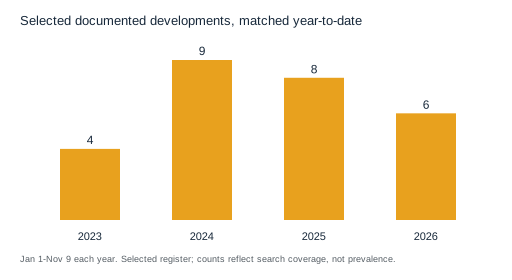
The public record is broad enough to justify attention across several portfolios, but it is uneven. An outbreak investigation, a selected retail test, a regulator's market-basket survey and a pleading-stage court order are different kinds of evidence. They should remain distinguishable in a board presentation as well as in technical files. This report's selected-event register is designed to show forms of scrutiny and response, not their prevalence in the entire food market.
| Category | Documented example in the review window | What the record can establish |
|---|---|---|
| Baby foods | 2023 cinnamon-containing applesauce recall; 2025 GreenWise pouch recall | Specific products were recalled; related testing and investigation have defined scopes. |
| Infant formula | FDA 2023-2025 market basket, released in 2026 | Results for a specified sample frame, with FDA assessment and lot-variability limits. |
| Cocoa and chocolate | October 2023 public testing; August 2024 Grausz order | Selected-test scrutiny and an actual dated litigation milestone. |
| Protein powders and shakes | Consumer Reports October 2025 investigation | Average results for 23 selected models and the tested lots. |
| Rice | HBBF May 2025 report | Selected rice measurements; ordinary rice and infant cereal require separate legal treatment. |
| Cinnamon and spices | FDA alerts beginning March 2024 and updated through November 2026 | Regulatory concern about named products, with a alert-selected numerical table. |
| Cassava and root-derived foods | 2025 U.S. public-testing investigation | Selected foods and ingredients drew public scrutiny; product changes require dated verification. |
| Dietary supplements | March 2025 Zaarah powder recall; published retailer testing requirements | A specific recall and concrete documentation gates for commercial access. |
One incident can generate many public documents. The applesauce event involved WanaBana, Schnucks and Weis brands, subsequent agency updates, import-related activity and a retailer warning letter. Those records should not become separate contamination incidents merely because they appear on separate webpages. Likewise, appeals in a single case do not indicate that several new lawsuits were filed. An event register should retain the underlying identity and record later milestones as linked developments.[15, 16]
The register also needs dates with meanings. A recall announcement date differs from the date FDA posts it. Publication of a test report differs from the specimen collection date. An update may add a new product, revise a conclusion or simply add a company response. Retaining those distinctions makes the register useful for preparedness. It also prevents a chart from manufacturing a sudden surge in contamination merely because old measurements became public in the same month.
Open full-size figure
Read measurements within their selection and product scope
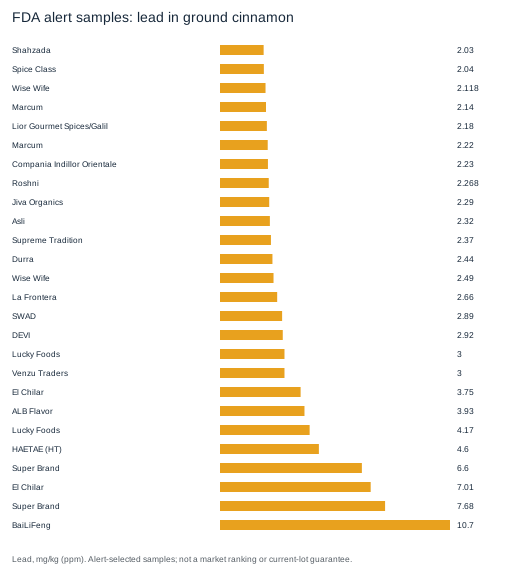
A numerical result can be exact in transcription yet misleading in presentation. The FDA combined cinnamon alert contains 26 printed lead results in the table inspected for this report. They come from products selected for an alert after elevated findings, not from a random sample of all ground cinnamon sold in the United States. The table does not provide a market denominator, exact collection dates, complete sample counts or analytical uncertainty. These gaps constrain the question the data can answer.[12]
Use this figure to demonstrate the importance of product and specimen identity. Do not turn it into a shopping league table or supplier score. A brand with one listed result is not thereby characterized across its portfolio, sourcing history or current production. A supplier absent from the table has not thereby passed a test. A later purchase can differ from the tested material. These are not excuses to disregard a finding; they are the boundaries within which a finding remains informative.
Consumer Reports' protein methodology supplies another useful boundary. The original study tested two or three unique samples or lots for each of 23 models, purchased between November 2024 and January 2025. Reported values average those tests, and inorganic-arsenic analysis was performed selectively. Its daily comparison assumes one serving and explicitly does not establish Proposition 65 compliance. A brand response should address the tested formula, flavor and purchase period, while supplying separately identified current evidence if the product has changed.[10]
Avoid using a cross-year series as proof of an industry-wide improvement unless the sample frame supports it. A 2024 cocoa paper used specimens purchased in 2014-2022 and explains that earlier results affected later product selection. That is valuable transparency, but it limits a simple before-and-after market narrative. Similarly, a formula comparison must preserve whether the concentration describes dry powder or formula prepared for feeding. A low concentration in one basis cannot simply be placed beside a higher concentration in another.[21, 22]
Open full-size figure
Separate demonstrated consequences from the competitive hypothesis
The commercial case for stronger evidence does not require an invented estimate of reputation damage. A recall can remove a product from sale, create handling work and require a consumer response. A channel can make verification a condition of eligibility. A dispute can consume management attention and legal resources. These are concrete business mechanisms. Their financial magnitude depends on the contract, product, distribution and incident; a selected public document rarely isolates all of those effects.
Publix's May 9, 2025 announcement concerned one GreenWise pear, kiwi, spinach and pea pouch product following routine sampling. It reported removal from shelves, refunds and no reported illnesses at that time. That establishes a documented response and its product scope. It does not measure how customers' confidence changed, how many switched brands or what the recall cost. Those questions require additional evidence rather than a multiplication of distribution size by assumed consumer behavior.[3]
CVS published a July 2024 all-lot withdrawal notice for a psyllium SKU because it failed its testing-program requirements. The failed attribute was not identified. This is evidence that program qualification can have a commercial consequence; calling it a heavy-metal recall would add a fact the notice does not contain. The distinction is especially important for a business developing an assurance claim: the quality of its own interpretation is part of the credibility it seeks.[4]
No causally isolated percentage sales loss or quantified trust decline was established in the evidence assembled here. A revenue decline in a company filing may coincide with many changes in price, distribution, product mix and strategy. A petition, article count or online discussion measures another phenomenon. Treat competitive advantage from stronger contaminant evidence as a hypothesis to evaluate. For example, a brand can track whether complete evidence files shorten buyer review, reduce repeated questions or prevent avoidable submission rejection. A favorable result can support a limited operational claim, with its own denominator and period.
Put the intended use at the center of ingredient purchasing
An ingredient is purchased for a formulation and a consumer use, not for an isolated concentration. A procurement team should therefore begin with the intended inclusion rate, serving size and destination market. The same ingredient can contribute different exposure amounts in two finished products. A supplier's generic specification may be useful background while remaining insufficient for a concentrated powder, a frequently consumed staple or a food intended for a young child. The purchasing decision needs the relationship between the ingredient and its use.
ICS proposes an intake record with six essential links: supplier and facility identity; ingredient description and physical form; lot and production dates; intended inclusion rate; applicable purchasing specification and its version; and the evidence supporting acceptance. Record a missing item as missing. Do not allow a product photograph, an undated summary sheet or a similar trade name to substitute for lot identification. The team should know exactly which uncertainty it has accepted and who authorized that decision.
Sourcing changes deserve the same discipline as new ingredients. A change in growing region, processor, blending practice or formulation can alter the relevance of historical results even when the commercial name stays the same. This is an ICS risk-management inference, not a universal requirement to reject a changed supplier. It suggests a defined change-notification clause and a review trigger. The question is whether the evidence still represents the material and process being bought, followed by a proportionate decision about additional sampling.
For rice, distinguish the ingredient's intended consumer use from a benchmark used in a public report. HBBF's 2025 report describes a 145-rice-sample subset and a larger appendix containing rice and other grains. Comparing ordinary rice with the infant-rice-cereal action level can frame an exposure discussion; it does not automatically subject every bag of rice to that cereal-specific level. A supplier challenge should ask for native results and intended-use assessment, rather than calling a comparison a legal failure.[11, 23]
Cassava illustrates why a broad ingredient name is also insufficient. Flour, starch, syrup and finished foods are different matrices and uses. The 2025 U.S. public-testing investigation drew attention to selected products; the Canadian regulator's separate survey provides context from another market and assessment. Neither authorizes a blanket assertion about every root crop or every current U.S. lot. Ask the supplier to describe the actual ingredient, the process and the applicable specimens. Preserve the distinction when briefing product development and marketing.[13, 24]
- Proposed purchasing checkpoint: the evidence file names the material and facility actually being offered.
- Proposed use checkpoint: the formulation team records the inclusion rate and label serving used in evaluation.
- Proposed change checkpoint: the supplier must notify the agreed contact when defined material or process changes occur.
- Proposed exception checkpoint: conditional acceptance has an owner, a reason and a review date.
Commission an analysis that can answer the decision
A laboratory request should describe the decision before it lists instruments. Identify the matrix, analytes, reporting basis, required sensitivity and intended interpretation. Ask whether the laboratory's accredited scope and validated method cover the relevant analysis. Accreditation is meaningful within scope; its presence should not be treated as automatic proof that every matrix, species or decision threshold is covered. If a subcontractor performs an analysis, preserve the responsible laboratory identity and the method that actually produced the result.
Sampling is a separate design task. Decide what the specimen is intended to represent: one package, a production lot, an incoming shipment or ongoing process performance. Document how units are chosen, whether increments are composited, and how a retained specimen is controlled. A composite can answer a different question from individual-unit testing. More analytical precision cannot repair an undisclosed sampling frame. This report recommends agreeing that frame with qualified staff before material is shipped, rather than reconstructing it from a courier receipt afterward.
Preserve the native laboratory result before performing conversions. Store the reported analyte, value, units, reporting basis, detection or quantification limits, result qualifiers and method version. Keep the original document alongside structured values. A derived per-serving amount should state the mass or volume used and the calculation. When moisture content or reconstitution affects a comparison, retain that information explicitly. A spreadsheet may make two cells look comparable even when their underlying specimens and bases differ.
The FDA formula program makes the basis issue tangible. Its earlier results summary presents concentrations as prepared for feeding, while current linked data are also provided as sold. The latter page explains that dry powder concentrations appear higher than reconstituted concentrations. A brand should state which form it is discussing and avoid selecting the lower-looking format solely for communication. The agency also characterizes the tested formula supply as safe while acknowledging monitoring and lot-variability limits. Both parts belong in a fair account.[7, 22]
Specify chemical form when it changes the question. Total arsenic and inorganic arsenic are not interchangeable labels. A total-metal result may be a screening input without resolving the assessment that requires speciation. A nondetect is limited by the method's sensitivity; it does not mean an analyte is absent. Request an explanation of any result that sits near a decision threshold, including relevant uncertainty and the agreed decision rule. Do not rewrite an uncertainty interval as an assured pass or invent additional precision through unit conversion.
Maintain a specification that keeps jurisdictions and purposes separate
A specification should be versioned as a decision instrument, not circulated as a context-free table. Each criterion needs a product scope, analyte definition, units, basis, effective date, jurisdiction and source. Record whether it is a binding legal maximum, nonbinding guidance, a warning-law safe harbor, a retailer requirement or a voluntary program criterion. Those categories can coexist in one assessment without being interchangeable. A business may choose a purchasing criterion stricter than a legal threshold, but it should identify that choice honestly.
FDA's final lead guidance for processed foods represented for children under two excludes infant formula, beverages and snacks such as puffs and teething biscuits. Its October 2026 cadmium document is draft guidance and is not for implementation. A California testing-and-disclosure duty is also different from a numerical contaminant limit. These distinctions matter when someone proposes copying a value from a headline into a global ingredient contract. Review the exact product and legal scope before making that value a rejection criterion.[25, 26, 27]
Proposition 65 safe harbors concern exposure-based warning exemptions. They are not universal concentration limits for every food. A publisher may use a dose benchmark under assumptions that differ from a legal warning assessment, as the protein methodology explicitly explains. The right operational response is to retain both the measured concentration and the consumption assumptions. Label a voluntary comparison as a comparison, then route legal warning questions to a separate review.[10, 28]
Export assessment adds another dimension. EU contaminant maximum levels are commodity-specific, and a provision may specify a basis or apply from a particular date. Great Britain and Northern Ireland can follow different frameworks. A single global green cell obscures these distinctions. ICS proposes a destination register in which a person can trace the relevant commodity classification, current rule version and decision basis. It is acceptable for one lot to require different documentation for two markets; pretending one generic certificate answers both creates unnecessary ambiguity.[29, 30]
| Register field | Purpose |
|---|---|
| Product and intended use | Prevents a criterion from moving to an excluded or different category. |
| Analyte identity and basis | Makes species, units and preparation state visible. |
| Authority and status | Distinguishes enacted rule, guidance, draft, contract and voluntary standard. |
| Version and effective date | Allows an old decision to be reconstructed and a new one to be reviewed. |
| Decision and reviewer | Records acceptance, hold or investigation with an accountable owner. |
Prepare evidence for the channel that will review it
Retailer requirements can be commercially decisive even when they are not legislation. Amazon's April 2024 announcement connects supplement eligibility with approved third-party testing, inspection and certification workflows and warns of potential listing removal when compliance is not confirmed by a due date. The announcement establishes a gate, not the number of products removed or the contamination reduction achieved. A brand should check the actual request for its listing rather than assuming that a familiar laboratory report will satisfy every channel.[2]
CVS's published supplier terms describe initial qualification, routine monitoring and documentation-only periods, with testing costs allocated to the seller. They also preserve a single-lot limitation. Its current corporate page confirms a continuing supplement-testing program. These materials support a practical distinction between belonging to a program and evidence about a particular current lot. The source of the obligation and the scope of the proof should remain visible in the submission.[31, 32]
ICS proposes assembling a channel evidence packet in the order a reviewer needs it. Begin with the product identifier and request being answered. Follow with the applicable requirement and version, the relevant laboratory evidence, any approved explanation of scope and the status of unresolved items. Include the responsible contact and a revision date. Retain the submitted version so that later correspondence does not silently overwrite what the reviewer actually received.
The packet should make exceptions easy to find. A report from a previous formulation, a supplier document awaiting confirmation or an uncompleted specification review should not be buried in a favorable summary. Describe the issue, the interim decision and the remaining evidence. If a channel's process requires a specific approved provider or direct submission route, follow it. A cryptographic record identifier or private data room can improve retrieval without overriding a retailer's own requirements.
Set a realistic internal deadline before the buyer's deadline. Quality needs time to review the specimen, not merely to upload a PDF. Procurement may need to obtain a traceable supplier response. Regulatory staff may need to check a claim. The proposed workflow assigns one coordinator while preserving each specialist's decision responsibility. Its performance can be measured as completeness and avoidable rework; it should not be advertised as guaranteed retailer acceptance.
Understand the different roles of public knowledge and private evidence
A useful evidence architecture does not require every record to become public. A literature reference, a private laboratory report, a certification decision and a supplier's commercial offering serve different readers. The public reference helps explain a question. The report describes a specimen. The certification decision applies a defined standard and scope. The commercial offering identifies material available for evaluation. Linking them can reduce confusion only if the links preserve these boundaries.
Open full-size figure
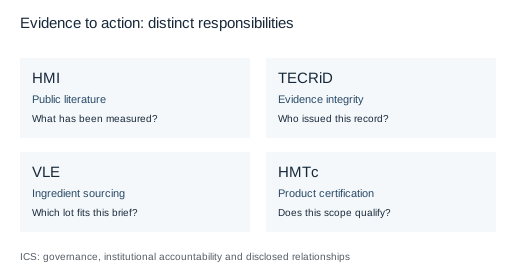
ICS's public sources describe HMI as a literature and regulatory reference rather than a repository for private brand COAs. TECRID is described as an identifier for laboratory evidence records with issuer provenance, status and version history. Its documented signatures and fingerprints support authentication. They do not establish specimen representativeness, suitable analysis, product safety or legal compliance. A verified signature answers who issued a record and whether it is intact; other evidence must support the substantive decision.[34, 36, 38, 39]
Brands should also distinguish uploading a historical report from laboratory issuance. The published TECRID intake pathway allows private historical-report intake and laboratory confirmation; upload alone does not create an issuer-authenticated laboratory record. Recipient access requires explicit authorization covering the recipient and scope. Withdrawal of a future access grant cannot erase copies already delivered. This makes access planning a practical responsibility rather than a promise that sharing can always be reversed.[40, 41]
TECRID's public offer describes a free core across roles, with optional paid implementation support. Production laboratory issuance is gated by identity and authority, competence evidence, approved scope, key control and signing conformance. The inspected public offering is not evidence that a particular laboratory has completed enrollment or that an end-to-end production exchange has been demonstrated. A brand should confirm those operational facts for its own proposed use before presenting the workflow to a buyer.[42, 43, 44]
VLE currently provides limited public browsing with documented lots and source reports. All six publicly displayed lots show No TECRID yet. It describes a buyer workflow for private needs, supplier sharing and evaluation. Its public material says production TECRID authentication and laboratory ordering are not connected yet; linked test records are sandbox evidence. A soft hold is an intention requiring supplier confirmation, with contracts and payment outside the platform. A brand can evaluate this published workflow while avoiding a claim that a proposed integration is already operational.[37, 45]
Communicate certification at the scope actually decided
A mark is most useful when a reader can discover what it covers. That requires more than naming a certification program. Identify the product and relevant variant, the standard version, decision status, applicable analytes and any time or lot boundaries. A finished-product decision does not automatically extend to every ingredient, supplier facility, production lot or product sold under the same brand. The same discipline should govern sales presentations and supplier questionnaires.[35]
HMTc's public standards are category-specific and use the product's stated native basis; some analyte cells are in development. Current published program rules make Certified the only marked status and route a published claim-analyte exceedance to unmarked Remediation. The public certificate lookup is presently pending and disabled, with a specimen illustration. Those facts do not demonstrate an issued production certificate for a named brand. Any participation or certification claim must therefore rely on the actual applicable decision and permitted wording.[35, 46, 47]
ICS proposes a claim review that reads the proposed wording as an ordinary customer would. Does the statement imply that no metals exist? Does it silently extend from one SKU to a whole brand? Does it suggest that a voluntary program decision establishes compliance everywhere? Does the mark appear beside ingredients or products outside its scope? The review should preserve a useful positive message while narrowing any implication that the evidence cannot support. This is an applied communication recommendation, not an independent endorsement of a program.
Treat a changed formula or manufacturing site as a reason to review the claim and its underlying decision. Keep a dated copy of the authorized artwork and the evidence used to approve it. If status changes, the team needs a controlled process for updating sales materials, website content and customer responses. A claim register helps make those updates coordinated. It cannot remove copies already circulating or relieve an organization of any disclosure or market-action obligation.
Use actual cases without converting procedure into causation
The Palmquist litigation is a particularly important reading test. On May 28, 2024, the Fifth Circuit held that Whole Foods had not been improperly joined, reversed the denial of remand and vacated the district-court judgment. On February 24, 2026, the Supreme Court unanimously affirmed the jurisdictional disposition. Its holding addressed an erroneous dismissal of a nondiverse party and the failure to cure the removal defect. Neither opinion establishes that the baby food caused the alleged injuries or that defendants were liable.[18, 19]
Hain's actual FY2026 SEC 10-K, filed September 14, 2026, says the case is pending in Brazoria County, Texas, discovery is ongoing and trial is set for March 29, 2027. The company denies the alleged injuries. This is a company-reported future setting as of the filing; the state docket was not revalidated for this report. A trial date can change. A brand discussing the case should include these limits rather than describing the Supreme Court decision as a food-safety verdict.[5, 48]
Chocolate litigation offers a different procedural example. The August 15, 2024 Grausz order partly granted and partly denied Hershey's dismissal motion. It rejected an insufficiently pleaded safety-hazard omission theory while other challenged theories remained. A claim surviving dismissal is not a finding that the allegation is true. A claim dismissed on that record is not a universal safety assurance for every product. This report does not establish the case's current final disposition.[9]
For internal learning, extract questions about records rather than imagined legal guarantees. Could the brand reconstruct its specifications at the relevant time? Can it distinguish a supplier statement from its own representation? Are formulation changes, customer communications and report amendments retained? These questions can improve readiness. They should be framed as ICS inferences about evidence control, not as proof that a particular database, test or certification would have prevented a claim or changed a court's outcome.
Give adverse findings a controlled path to improvement
A credible evidence program needs somewhere for a problem to go. If every result is treated as immediate marketing material, staff may have little space to investigate a discrepancy carefully. If confidentiality is treated as permission to suppress required action, the program fails for another reason. The proposed operating model gives technical investigation a defined private workspace while preserving regulatory, contractual and public-health duties.
HMTc's published readiness pathway describes confidential pre-certification review, quantitative results and a corrective roadmap before the official decision. Its confidentiality boundary does not delay required reporting, withdrawal, recall or lawful disclosure. Brands considering that pathway should ask who controls the records, who receives them, what triggers escalation and how later decisions are documented. Confidential improvement is a process description; it does not mean every finding is legally confidential or immune from disclosure.[49, 50]
ICS proposes an exception file that starts with the observed discrepancy rather than a preferred explanation. Preserve the original result and specimen identity. Identify any immediate hold or other required action through the appropriate responsible functions. Review sampling, laboratory method, units, basis and specification version. Ask whether a supplier or process change could explain the finding. Each proposed explanation should have evidence that could support or reject it. Do not simply repeat tests until a favorable result appears.
A follow-up test needs a stated purpose. Retesting the retained specimen can investigate analytical disagreement; sampling a new lot examines different material. Neither silently replaces the original result. If a report is corrected, retain the issuer's amendment and identify what changed. If a process improvement is introduced, document its effective point and verify performance using a justified plan. A successful result after a change supports a narrower conclusion than proof that all earlier or future product conforms.
Close the exception only when the owner can explain the decision. The record should identify the root-cause conclusion or remaining uncertainty, action taken, verification performed, disposition of affected material and any communication required. Some investigations end with an unresolved cause; that uncertainty should remain visible. A private file can still be decision-ready. Public communications can then describe the confirmed response at the appropriate scope without publishing unnecessary commercial details or overstating certainty.
Make the consumer explanation narrower and clearer
A useful consumer explanation begins with the product and the current question. If a report covers a particular lot or formula, say so. If a company has changed its sourcing or formulation, distinguish the change date from the test period. If additional testing is underway, explain the scope of that work and where a dated update will appear. A short factual answer is usually more durable than a sweeping assurance assembled before the evidence is reviewed.
Avoid the unsupported shorthand of zero metals, toxin-free or universally safe. A nondetect is a result under specified detection conditions. A passing specification is a decision under a defined criterion. An authenticated report is an intact issuer record. A certification is a scoped program decision. A public explanation can translate these distinctions into plain language without presenting a technical appendix as the main customer journey. The underlying file should nevertheless be available to the people responsible for answering detailed questions.
Present an available company response fairly when discussing an external test. A later-lot result may be relevant but may not contradict the original specimen. A discontinued formula may remain in a consumer's pantry. A disagreement about the benchmark may leave the measured value uncontested. State which part is disputed and which is confirmed. Consumer Reports includes manufacturer responses in its protein investigation; brands should preserve that same distinction when they cite public findings about themselves or competitors.[20]
ICS proposes a communication approval sheet with the proposed wording, intended audience, evidence link, scope limitations, review owner and expiration or reassessment trigger. Include foreseeable short versions used by sales partners and social accounts. The exercise is not intended to make every message longer. Its purpose is to ensure that a short message remains true after the qualifications are removed from a presentation slide or compressed into a product listing.
A proposed ninety-day implementation sequence
The following sequence is an ICS proposal for a brand that has scattered evidence and needs a workable starting point. It is not a promise of certification, retailer acceptance or a particular business result. Adapt it to the portfolio, existing controls and applicable obligations. Where an immediate finding requires action, do not wait for the sequence to finish.
| Period | Proposed work | Reviewable output |
|---|---|---|
| Days 1-15 | Choose a small set of consequential products and identify decisions, claims and evidence owners. | Product scope list, current claims inventory and missing-record register. |
| Days 16-30 | Reconcile specifications with matrix, analytes, jurisdictions and buyer requirements. | Versioned criteria register and a documented sampling/laboratory brief. |
| Days 31-60 | Obtain or commission suitable evidence; review exceptions through responsible functions. | Traceable files, explicit uncertainty and corrective-action ownership. |
| Days 61-90 | Prepare channel packets and approved public wording; review process performance. | Dated submission packet, claim register and baseline operational metrics. |
During the first period, resist a portfolio-wide spreadsheet that nobody can maintain. Select products where the evidence is consequential and the scope is clear. Identify the person who can authorize a release decision, the person who owns supplier follow-up and the person who can approve a public claim. Map where the original reports reside. This creates a manageable pilot for the process, without implying that unselected products have passed or failed.
During the specification period, review one real decision from beginning to end. Reconstruct the product identity, basis and rule version; check the comparison; locate the authorizing record. If staff cannot reproduce the decision, record the missing link before buying new software. A technical platform can improve retrieval but cannot supply a sampling plan, a legal classification or a justified specification that the organization never established.
During evidence collection, prioritize suitability over the appearance of completeness. An old supplier COA can be retained as historical context while a current question remains unresolved. A new laboratory request should have a clear purpose and record dependencies. Hold regular short reviews of exceptions so that one unresolved supplier question does not disappear behind a growing number of uploaded files. Escalation criteria should be defined by the responsible functions rather than invented after a difficult result arrives.
During the final period, test the packet with an internal reviewer who did not assemble it. Can that person identify the product, find the current criterion, trace the result and understand the exception status? Ask marketing to explain the claim in one paragraph and quality to check that explanation against the file. Record the time and rework required. These observations form a baseline for process improvement; they are not consumer research or evidence of a sales effect.
Three hypothetical decisions that expose common evidence gaps
Scenario one concerns a powdered food with two plant-derived ingredients. Purchasing receives an authentic supplier COA, but the report names a blend family rather than the offered lot. The laboratory result is expressed on a dry basis, while the purchasing specification refers to the ingredient as supplied. The formulation team also increased the ingredient inclusion rate after the specification was written. A quick "passed COA" response would conceal three separate questions: identity, basis and intended use.
The proposed response is to preserve the supplied document and request the missing identity link. Quality and the laboratory determine whether a justified basis conversion is possible or whether a new measurement is needed. Formulation records the current inclusion rate and serving assumptions, and regulatory staff review the relevant destination criteria. The decision remains pending or otherwise controlled under the company's applicable procedures until the responsible owner has adequate evidence. No invented arithmetic is necessary to make the scenario useful; the important output is a reproducible reasoning path.
Scenario two concerns a product selected in an external public test. The company has a newer formula with lower internal results, and sales wants to state that the external findings are false. The purchase date in the public methodology predates the formula change. The proposed response separates the old and new products, checks whether the external specimen identity matches the historical formula and describes the newer evidence with its own dates, lots and methods. A change in product does not erase the earlier finding.
The communication team can explain what is known, what changed and what the newer measurements cover. If it disputes the test method or benchmark, the response should identify the disputed point. If only the interpretation is disputed, it should not deny the measured concentration. Internal improvement goals can remain private where appropriate while required actions proceed. The learning objective is a more accurate response, not a guarantee that coverage, complaints or sales will improve.
Scenario three concerns a retailer requesting evidence through an approved verification workflow. The brand has a privately stored authenticated report and assumes that sending its identifier will complete qualification. The buyer instead needs a defined provider route, product-specific documentation and a response before a deadline. The proposed coordinator maps the retailer's request to the available file and identifies the remaining steps. Authentication is retained as a useful feature while the channel's actual acceptance requirements are satisfied.
The same scenario tests permission. A private report shared with one buyer should not automatically become accessible to every distributor or public visitor. The controller specifies recipients and permitted scope, and the record explains what can be withdrawn prospectively. If the buyer already downloaded the document, access revocation cannot recover that copy. The team therefore approves sharing deliberately at the start. A successful outcome would be a complete, authorized submission with an auditable decision trail; it would not by itself establish product safety or a certification decision.
Measure the operating result and disclose the report\u2019s boundaries
A brand can evaluate the proposed approach without turning analytical concentrations into a composite danger score. Useful process measures include the proportion of priority products with complete identity links, the time needed to retrieve a decision file, repeat requests caused by missing information, overdue exceptions and claims awaiting review. Define the denominator and observation period. Track changes against a stable baseline and investigate whether a shift reflects better records or simply a different product mix.
Customer-facing outcomes require their own methods. A satisfaction survey needs a defined sample and question wording. A sales analysis needs a credible comparison and controls for other changes. A retailer's faster response may reflect staffing rather than the new packet. Treat early observations as evidence to examine, not automatic proof of causation. A narrow statement such as improved file retrieval within the measured team can be useful without being stretched into a promise of greater market trust.
This report used public regulator pages, original testing publications or publisher-indexed material, court texts, a company SEC filing and published retailer documents. The event register was selected for relevance, not assembled as a systematic census. Cinnamon measurements were transcribed with missing collection dates and n retained as unknown. Two testing-publisher pages were inspected through indexed original content after direct retrieval returned 403; their product-level numerical results were not plotted. Litigation snapshots and future trial settings require continued checking.[8, 12, 13]
Institute of Contaminant Standards is the publisher and corporate author. ICS, HMI and HMTc disclose a shared Paleo Certified, Inc. operator; related ecosystem services discussed here have an institutional relationship to the publisher. This report is not an independent third-party endorsement of those services. ICS's public governance material describes ISO/IEC 17065 accreditation as being pursued and its committee as being constituted. Neither should be represented as completed. The report's operational playbooks, scenarios and proposed advantages are ICS analysis rather than validated intervention findings.[38]
SOURCES REVIEWED
References
- [1]U.S. Food and Drug Administration. (2024, July 9). Formulation Technology, Inc. — 672905 — 07/09/2024. https://www.fda.gov/inspections-compliance-enforcement-and-criminal-investigations/warning-letters/formulation-technology-inc-672905-07092024
- [2]Amazon Seller Central. (2024). Listings Lounge: New requirements for dietary supplements. https://sellercentral.amazon.com/seller-forums/discussions/t/3c89099d-06aa-453f-95a6-a2eea54260ab
- [3]Publix Super Markets, Inc. (2025, May 9). Publix voluntarily recalls GreenWise Pear, Kiwi, Spinach & Pea baby food pouches due to lead. https://www.fda.gov/safety/recalls-market-withdrawals-safety-alerts/publix-voluntarily-recalls-greenwise-pear-kiwi-spinach-pea-baby-food-pouches-due-lead
- [4]CVS Pharmacy. (2024, July 12). CVS Health Natural Fiber Supplement 100% Psyllium: Product information. https://www.cvs.com/content/dam/enterprise/cvsretail/help-assets/recall_pdf/Final-CVS%20Health%20Psyllium%20Fiber%20Supplement%20SKU%20689581.pdf
- [5]The Hain Celestial Group, Inc. (2026, September 14). Annual report on Form 10-K for the fiscal year ended June 30, 2026. https://www.sec.gov/Archives/edgar/data/910406/000119312526390505/hain-20260630.htm
- [6]U.S. Food and Drug Administration. (n.d.). Investigation of elevated lead & chromium levels: Cinnamon applesauce pouches (November 2023). https://www.fda.gov/food/outbreaks-foodborne-illness/investigation-elevated-lead-chromium-levels-cinnamon-applesauce-pouches-november-2023
- [7]U.S. Food and Drug Administration. (2026). FDA’s infant formula product testing results. https://www.fda.gov/food/infant-formula-homepage/fdas-infant-formula-product-testing-results
- [8]Consumer Reports. (2023, October 25). Consumer Reports urges Hershey’s to get heavy metals out of chocolate products. https://www.consumerreports.org/media-room/press-releases/2023/10/consumer-reports-urges-hersheys-to-get-heavy-metals-out-of-chocolate-products/
- [9]U.S. District Court for the Southern District of California. (2024, August 15). Grausz v. The Hershey Company, No. 3:23-cv-00028-AJB-SBC, Document51. https://law.justia.com/cases/federal/district-courts/california/casdce/3:2023cv00028/750139/51/
- [10]Consumer Reports. (2025, October). Test methodology: Heavy metals in protein supplements. https://article.images.consumerreports.org/image/upload/v1761140939/prod/content/dam/CRO-Images-2025/Special%20Projects/Consumer-Reports-Protein-Powders-and-Shakes-Contain-High-Levels-of-Lead-Methodology-Test-Results-v2.pdf
- [11]Healthy Babies Bright Futures. (2025, May 27). What’s in your family’s rice? https://hbbf.org/sites/default/files/2025-05/Arsenic-in-Rice-Report_May2025_R6_SECURED.pdf
- [12]U.S. Food and Drug Administration. (2026, November 4). More ground cinnamon products added to FDA public health alert due to presence of elevated levels of lead. https://www.fda.gov/food/alerts-advisories-safety-information/more-ground-cinnamon-products-added-fda-public-health-alert-due-presence-elevated-levels-lead
- [13]Loria, K. (2025, May 8). Cassava flour, chips, bread, and more contain high levels of lead. https://www.consumerreports.org/health/food-contaminants/cassava-flour-chips-bread-more-contain-high-levels-of-lead-a7817220954/
- [14]New York Wholesale Group. (2025, March 10). New York Wholesale Group recalls Zaarah Herbals Rasayan Churan, Gurmar Powder, Vasaka Powder and Bhringraj Powder because of possible health risk. https://www.fda.gov/safety/recalls-market-withdrawals-safety-alerts/new-york-wholesale-group-recalls-zaarah-herbals-rasayan-churan-zaarah-herbals-gurmar-powder-zaarah
- [15]U.S. Food and Drug Administration. (n.d.). Post-incident response activities: Elevated lead and chromium levels in cinnamon applesauce pouches. https://www.fda.gov/food/outbreaks-foodborne-illness/post-incident-response-activities-elevated-lead-and-chromium-levels-cinnamon-applesauce-pouches
- [16]Supreme Court of the United States. (n.d.). Docket for 24-724: The Hain Celestial Group, Inc. v. Palmquist. https://www.supremecourt.gov/docket/docketfiles/html/public/24-724.html
- [17]Centers for Disease Control and Prevention. (2025, April 17). Investigation of lead and chromium exposure after consumption of contaminated cinnamon-containing applesauce — United States, November 2023–April 2024. https://www.cdc.gov/mmwr/volumes/74/wr/mm7414a2.htm
- [18]U.S. Court of Appeals for the Fifth Circuit. (2024, May 28). Palmquist v. Hain Celestial Group, Inc., No. 23-40197, 103 F.4th 294. https://www.ca5.uscourts.gov/opinions/pub/23/23-40197-CV0.pdf
- [19]Supreme Court of the United States. (2026, February 24). The Hain Celestial Group, Inc. v. Palmquist, No. 24-724, 607 U.S. ___. https://www.supremecourt.gov/opinions/25pdf/24-724_igdj.pdf
- [20]Martineau, P. (2025, October 14). Protein powders and shakes contain high levels of lead. https://www.consumerreports.org/lead/protein-powders-and-shakes-contain-high-levels-of-lead-a4206364640/
- [21]Hands, J. M., Anderson, M. L., Cooperman, T., Balsky, J. E., & Frame, L. A. (2024, July 31). A multi-year heavy metal analysis of 72 dark chocolate and cocoa products in the USA. https://www.frontiersin.org/journals/nutrition/articles/10.3389/fnut.2024.1366231/pdf
- [22]U.S. Food and Drug Administration. (2026). FDA’s testing of infant formula. https://www.fda.gov/food/infant-formula-homepage/fdas-testing-infant-formula
- [23]U.S. Food and Drug Administration. (2020, August 5). FDA issues final guidance for industry on action level for inorganic arsenic in infant rice cereals. https://www.fda.gov/food/hfp-constituent-updates/fda-issues-final-guidance-industry-action-level-inorganic-arsenic-infant-rice-cereals
- [24]Canadian Food Inspection Agency. (2026). Toxic metals in selected foods — April1, 2023, to March31, 2024. https://publications.gc.ca/collections/collection_2026/acia-cfia/A104-247-1-2026-eng.pdf
- [25]U.S. Food and Drug Administration. (2025, January 6). FDA issues final guidance for industry on action levels for lead in processed food intended for babies and young children. https://www.fda.gov/food/hfp-constituent-updates/fda-issues-final-guidance-industry-action-levels-lead-processed-food-intended-babies-and-young
- [26]U.S. Food and Drug Administration. (2026, October). Action levels for cadmium in processed food intended for babies and young children: Draft guidance for industry. https://www.fda.gov/media/195793/download
- [27]California Department of Public Health. (n.d.). Assembly Bill (AB) 899: Food safety—Baby food: Frequently asked questions. https://www.cdph.ca.gov/Programs/CEH/DFDCS/Pages/FDBPrograms/FoodSafetyProgram/AB899FAQ.aspx
- [28]Office of Environmental Health Hazard Assessment. (n.d.). Proposition 65 no significant risk levels (NSRLs) and maximum allowable dose levels (MADLs). https://oehha.ca.gov/proposition-65/general-info/proposition-65-no-significant-risk-levels-nsrls-and-maximum-allowable-dose-levels-madls
- [29]European Commission. (2026, August 19). Consolidated text: Commission Regulation (EU) 2023/915. https://eur-lex.europa.eu/eli/reg/2023/915/eng
- [30]Food Standards Agency. (2018, January 30). Chemical contaminants. https://www.gov.uk/government/publications/chemical-contaminants/chemical-contaminants
- [31]CVS Pharmacy, Inc. (n.d.). Dropship terms and conditions, Appendix 3: Tested to Be Trusted program. https://cvssuppliers.com/sites/launch/files/2025-07/CVS%20Dropship%20T%26C%20FINAL.pdf
- [32]CVS Health. (n.d.). Healthy business: Product integrity. https://www.cvshealth.com/impact/healthy-business.html
- [33]Institute of Contaminant Standards. (n.d.). Institute of Contaminant Standards. https://contaminantstandards.com/
- [34]Pendergrass, K. (2026, April 24). About. https://heavymetalindex.com/about
- [35]Pendergrass, K. (n.d.). Program structure. https://heavymetalcertified.com/program/structure
- [36]Institute of Contaminant Standards. (2026, August 29). What is a TECRID? https://tecrid.com/what-is-a-tecrid
- [37]Verified Lot Exchange. (n.d.). Know what is in the lot before you buy it. https://vle.exchange/
- [38]Institute of Contaminant Standards. (n.d.). Governance. https://contaminantstandards.com/governance
- [39]Institute of Contaminant Standards. (n.d.). TEC Registry API: Canonicalize, sign, issue, resolve. https://tecrid.com/developers
- [40]Institute of Contaminant Standards. (n.d.). TECRID for brands and ingredient suppliers: Verifiable COA portfolios. https://tecrid.com/for-brands
- [41]Institute of Contaminant Standards. (2026, August 29). TECRID privacy and data governance. https://tecrid.com/privacy
- [42]Institute of Contaminant Standards. (n.d.). Join TECRID. https://tecrid.com/join
- [43]Institute of Contaminant Standards. (n.d.). TECRID for laboratories: Issue verifiable laboratory reports. https://tecrid.com/for-laboratories
- [44]Institute of Contaminant Standards. (n.d.). TECRID frequently asked questions. https://tecrid.com/faq
- [45]Verified Lot Exchange. (n.d.). How does this work? https://vle.exchange/how-it-works
- [46]Heavy Metal Tested & Certified. (n.d.). HMTc standards. https://heavymetalcertified.com/standards
- [47]Heavy Metal Tested & Certified. (n.d.). Verify a certificate. https://heavymetalcertified.com/verify
- [48]U.S. Securities and Exchange Commission. (2026, September 14). Filing detail: Hain Celestial Group Inc., accession 0001193125-26-390505. https://www.sec.gov/Archives/edgar/data/910406/000119312526390505/0001193125-26-390505-index.htm
- [49]Pendergrass, K. (2026, August 20). The readiness pathway. https://heavymetalcertified.com/program/readiness
- [50]Pendergrass, K. (2026, August 20). Corrective action. https://heavymetalcertified.com/program/corrective-action
Institute of Contaminant Standards. (2026). Heavy Metals and the Brand Evidence Advantage. ICS Evidence Review. ICS-ER-2026-003, version 1.0.1.
Publication package SHA-256: f52fb857f1f87cc39dd3603cd61e13da753e3f9f05f11a1468e7e70f891ed2ebVersion history and file fingerprints