HEAVY METALS SPECIAL REPORT
From Ingredient Lots to Defensible Evidence
A practical contaminant-evidence guide for ingredient suppliers, technical sales teams, and procurement partners
Version 1.0.1 · Evidence checked through 2026-11-09 · Free download
An ingredient supplier's most useful contaminant claim is a claim that a buyer can connect to a defined material, lot, sample, method, and intended application. This report proposes a practical dossier and decision process for making that connection. It distinguishes a test result from an exposure assessment, a contractual specification from a legal maximum level, and an evidence exchange from certification. The operating models, procurement examples, and suggested metrics are original Institute of Contaminant Standards proposals, not findings of proven commercial or health benefit.
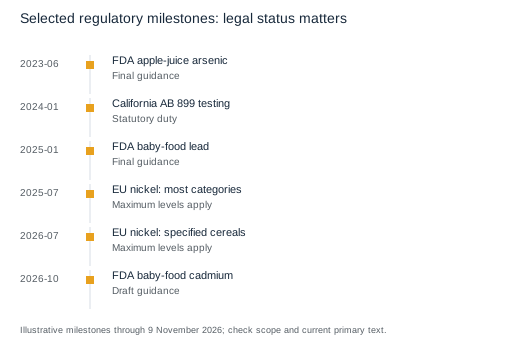
The regulatory setting is changing unevenly. FDA finalized lead action levels for specified processed baby foods in January 2025 and released proposed cadmium action levels in October 2026. California's AB 899 imposes testing and disclosure duties, while EU nickel maximum levels have phased application dates in 2025 and 2026. These developments reward careful application mapping; they do not create one worldwide heavy-metals specification for every ingredient.[1, 2, 3, 4]
What an evidence-ready supplier can actually demonstrate
The central finding of this selected-source review is a mismatch between the question buyers often ask and the evidence a generic certificate can answer. A buyer asks whether an ingredient can support a particular finished product in a particular market. A laboratory report usually answers a narrower question about the material received and tested. The commercial task is to connect those questions without pretending that one result resolves the entire product decision. An evidence-ready supplier makes the connection visible: what the material is, which supply it represents, how it was sampled, what was measured, and which proposed application has been evaluated. This is an ICS interpretation of the decision problem, not a measured description of every supplier's current practice.
Three distinctions should structure that conversation. Measured occurrence describes a concentration or other analytical observation. Exposure depends additionally on how much is consumed and by whom. Regulatory conformity depends on the applicable jurisdiction, commodity, analyte definition, and legal or guidance instrument. Health Canada explicitly considers both concentration and consumption when developing maximum levels and warns that the absence of a listed maximum does not exempt food from general safety law. A supplier dossier should therefore preserve these distinct questions rather than collapse them into an unqualified safe or unsafe label.[5]
A useful supplier position is narrower and more durable than a broad superiority claim: this identified lot has a documented result; this agreed sampling plan explains its scope; this application calculation uses declared assumptions; and these conditions trigger further review. The proposed benefit is decision clarity. It may reduce repeated requests or allow a buyer to assess an alternative material more quickly, but those outcomes have to be measured. This report does not establish that evidence programs command a price premium, increase sales, prevent litigation, or reduce disease. Such claims would require evidence beyond regulatory documents and a proposed operating model.
Start with the material and the decision
Before choosing a test panel, the supplier and buyer should write a one-page application brief. Identify the ingredient's common and technical names, physical form, relevant processing steps, country or region of production where known, supplier lot identifier, intended markets, and customer product type. State whether the buyer is evaluating a conventional food, an infant or young-child food, a dietary supplement, or another regulated category. Include the proposed inclusion rate or maximum daily intake. These are proposed dossier fields. They are intended to prevent a discussion about a bulk powder from silently becoming a claim about every product made from that powder.
Define the decision in operational terms. Is procurement qualifying a new origin, comparing two process versions, accepting an incoming shipment, or deciding whether a change requires renewed qualification? Each decision calls for a different evidence boundary. A qualification exercise concerns a supply relationship over time. A release decision concerns identified material. A process comparison concerns a controlled change. A customer response concerns a specific question and record set. Reusing the same document across all four can conceal what is missing. ICS proposes that the dossier begin with its decision purpose, intended users, and expiration or review conditions so its limitations travel with the result.
Do not use a finished-product requirement as an unexplained raw-material specification. In some applications the buyer may deliberately allocate only part of its finished-product contaminant budget to one ingredient. That can be a sensible contractual design, but the allocation should identify the other ingredients, intended formulation, processing assumptions, and remaining uncertainty. The supplier should call it the buyer's application specification. A customer requirement can be more restrictive than a directly applicable legal benchmark without becoming the law for all sellers or all uses of that ingredient. Conversely, meeting a buyer's stated number does not establish that every other requirement has been met.
Write the claim boundary as a sentence that could survive being copied into an email. An ICS model is: results concern the identified sample and lot under the documented sampling plan; suitability for the stated application depends on the listed assumptions and the buyer's finished-product assessment. The sentence should sit beside the result, not only in remote terms and conditions. If the dossier is later summarized for technical sales, preserve the lot, analyte, and application qualifiers. A shorter summary that drops those qualifiers has changed the claim even when the underlying numerical value remains unchanged.
Use origin and processing information to form testable hypotheses
FDA describes environmental metals as entering foods through the environments where plants and animals grow or are raised. Its lead guidance announcement explains that contaminants can be taken up alongside nutrients. This supports asking suppliers about sourcing and process history. It does not support assigning a contaminant concentration to an untested farm, region, certification category, or ingredient. An origin label is context for investigation, not an analytical result. For a supplier changing origins, the practical question is whether the evidence program can detect and explain a meaningful change in incoming material under comparable measurement conditions.[1]
FDA's cadmium draft illustrates why a commodity-wide average can be a poor substitute for a specific formulation question: its proposed categories distinguish single-ingredient carrots and dry infant cereals from several other baby-food groups. The draft discusses carrots' capacity to absorb cadmium from soil. This is a supported pathway and policy rationale for that food context; it does not establish that every carrot lot is higher than every competing ingredient. A supplier can use the example to ask a better question about its own material, then obtain evidence rather than transpose the draft's dataset into an untested ranking.[6]
Processing history is also a legitimate investigation field. Health Canada's NHP quality guidance identifies environmental contamination, manufacturing catalysts, and inadvertent introduction through equipment as possible elemental-impurity pathways. Its consultation draft additionally discusses concentration changes during botanical preparation. Neither document proves the cause of a result in a particular food ingredient. ICS proposes recording equipment-contact changes, extraction or concentration steps, water sources, and material balances as candidate explanatory variables. The supplier should distinguish a known process change from a suspected contamination mechanism and from a mechanism supported by paired measurements.[7, 8]
A private improvement investigation can then separate three questions. Did the incoming material change? Did the process change its distribution or concentration? Did sampling or analytical practice change? Start by mapping the actual flow of the material through receiving, storage, preparation, processing, and packing. Mark where the lot identity changes or is combined with other supply. Select observation points that would distinguish competing explanations. This is an ICS proposed investigation method. It is preferable to a retrospective story that attributes an unfavorable number to soil or machinery simply because those explanations sound plausible.
The same discipline applies to a favorable outcome. A lower value after an intervention is an observation, not automatically evidence of causation. Record what else changed: source material, blending proportions, water content, laboratory, extraction method, reporting limit, or sampling location. Compare retained or paired samples where feasible and appropriate, and ask the laboratory what comparisons its method supports. The proposed output is a documented explanation with remaining uncertainties, not a promotional before-and-after graphic stripped of context. If the explanation remains uncertain, the quality record should say so and define the next discriminating check.
Read United States requirements by product and instrument
The United States examples show why a single heavy-metals limit is an unreliable starting point. FDA's January 6, 2025 final lead guidance uses 10 ppb for specified processed baby-food groups and 20 ppb for single-ingredient root vegetables and dry infant cereals. It concerns foods represented for children under two and excludes infant formula, beverages, and specified snacks. These are nonbinding action levels used alongside other information in enforcement decisions. An ingredient supplier should identify whether a customer's finished product falls within that scope before treating the numbers as an application target.[1]
Arsenic requires equal care with species and commodity. FDA's final infant-rice-cereal action level is 100 µg/kg inorganic arsenic; its final apple-juice action level is 10 ppb inorganic arsenic. Neither is a universal total-arsenic limit for all rice ingredients, beverages, or supplements. When a customer forwards one of these numbers, the technical response should identify the intended finished food and the analyte being requested. A total-arsenic result and an inorganic-arsenic criterion are not automatically interchangeable. A supplier should request a suitable speciation strategy when that distinction controls the customer's assessment.[9, 10]
Dietary-supplement CGMP provides a different kind of requirement. FDA's compliance guide explains the duty to establish specifications, including relevant contamination limits, and to verify applicable specifications. The guide does not turn an ingredient's generic certificate into a universal finished-supplement clearance. ICS proposes giving supplement customers the data needed to connect their maximum daily intake, ingredient quantity, and contaminant specification to a defined lot. Where the supplier's contractual acceptance level comes from a customer's formulation assessment or an identified compendial approach, name that basis instead of calling it an unspecified FDA limit.[11]
California AB 899 is an especially useful example of a different regulatory instrument. CDPH describes monthly testing duties for arsenic, cadmium, lead, and mercury beginning in 2024 and website disclosure duties beginning in 2025. The law does not itself set numerical metal maxima. A supplier supporting a covered baby-food customer may need to provide traceable ingredient information, but the supplier's private testing does not by itself perform the manufacturer's final-product duties. Keep ingredient evidence, final-product testing, and the customer's publication obligations as distinct items in the application brief.[3]
Do not overlook proposals when managing future requirements, but keep them separate from current acceptance rules. FDA released a baby-food cadmium draft on October 22, 2026, with comments requested by December 22, 2026. It is explicitly not for implementation. A supplier may model how a customer's specification could change if the proposal were finalized, clearly labeling the exercise as planning. Such a scenario should never be displayed as an existing statutory violation or described as a promise that the final guidance will retain the proposed values.[2, 6]
Open full-size figure
Build a market map instead of a worldwide pass mark
EU Regulation 2023/915 sets maximum levels by listed food category. Its general rules restrict placing covered food on the market or using it as an ingredient when an applicable maximum is exceeded. The default basis is food as marketed and the edible portion, with specific remarks and provisions for dried, diluted, processed, and compound foods. Consequently, a supplier should preserve the exact classification and calculation used for a proposed European application. The analysis should be reproducible by another reviewer without relying on a salesperson's statement that a material is EU compliant.[12]
Two examples demonstrate the importance of the annex structure. The original regulation specifies food-supplement maxima for lead, cadmium, and mercury, with a distinct cadmium provision for qualifying seaweed or bivalve products. It also contains inorganic-tin provisions for specified canned foods and beverages. Those categories are not a ready-made specification for every bulk ingredient. For cocoa, the consolidated text differentiates cadmium values by chocolate composition and specified consumer cocoa-powder uses. A buyer's formulation and category can therefore matter as much as the concentration recorded on the ingredient certificate.[12, 13]
Nickel adds a recent change with explicit timing. Regulation 2024/1987 applies most covered nickel maximum levels from July 1, 2025, while the listed cereal entries apply from July 1, 2026. Its categories include nuts, vegetables, seaweed, pulses, oilseeds, cereals, cocoa products, infant foods, and juices, with different values and remarks. This supports maintaining a controlled nickel requirement map for relevant customer applications. It does not support one global nickel limit, nor does a total-nickel result resolve every question about a differently defined nickel compound.[4]
California's Proposition 65 supplies another distinct framework. OEHHA's safe-harbor table uses exposure-based warning exemptions, including an oral lead MADL of 0.5 µg/day and an oral cadmium MADL of 4.1 µg/day. These are not federal food concentration limits. Its reproductive-toxicity listing for nickel specifically addresses soluble compounds, defined by the agency using water solubility. A supplier should avoid using a total-nickel concentration to imply that the soluble-compound listing has been directly assessed. Name the question that was evaluated and disclose what the test cannot establish.[14, 15]
Canada and the United Kingdom also require distinct treatment. Canada's incorporated list includes species-specific arsenic levels for specified rice and juice categories, while another Health Canada list gives mercury levels for retail fish. Natural health products have a separate quality-guidance context, including daily-intake acceptance values and a consultation draft that must not be presented as final replacement guidance. England and Wales use assimilated Regulation 1881/2006; Northern Ireland uses EU 2023/915, and Food Standards Scotland identifies the GB/EU distinction. A distributor's international footprint is therefore a reason to maintain several application assessments, not to erase their differences.[5, 7, 8, 16, 17, 18]
Make the sample\u2019s relationship to the lot reviewable
Start with the physical population. Record the supplier lot and any upstream lots, the amount supplied, container count and type, production or packing interval, and whether the material was combined, repacked, or subdivided. Explain how the lot boundary was chosen. A code generated for shipping convenience may be useful for logistics, but the evidence reviewer still needs to know what material the code represents. If the incoming shipment contains several upstream populations, a single customer-facing code should not make those populations disappear from the quality record.
Next record selection: who selected the containers or locations, when selection occurred, which portions were sampled, how increments were collected and combined, and whether the customer or a third party observed any steps. Preserve the written plan that existed before the result was known. If sampling departed from the plan, record the departure and assess its implications. A laboratory's identity and competence concern the analytical work; they do not automatically establish that a supplier-selected sample represents every container. The dossier should describe these as separate responsibilities.
Define what the proposed test is intended to support. A composite may answer a question about the combined material represented by that composite while providing less information about individual locations or containers. An individual-container design answers a different question and may be more demanding to execute. The appropriate design depends on the decision and the material. ICS proposes that the supplier ask a qualified sampling specialist to align selection, sample preparation, and decision criteria, rather than promise representativeness because the sample was large or because several increments were combined.
Preserve custody and retention details in a form a buyer can audit. Record sample identifiers, seals where used, transfer dates, storage conditions relevant to sample integrity, laboratory receipt, and the disposition of retained material. Define when a retained sample may be used for an investigation and what its condition can support. A retained specimen can be valuable, but a later test should be labeled as a later test of that specimen. It must not silently overwrite the original report or imply that the original analytical history never occurred.
Avoid inventing a universal testing frequency. The supplier's proposed frequency should respond to the material, source variability, process controls, customer use, applicable legal duties, and observed history. Explain what triggers additional testing or requalification: an origin change, process change, unusual result, documented deviation, or another defined signal. Reduced routine testing, where appropriate and permitted, should be a reasoned decision with review conditions. The objective is an explicit evidence policy that can be challenged and improved, not a frequency selected because it is inexpensive or reassuring to print.
Keep the analytical details that make comparisons possible
The analytical record should identify the laboratory, report and sample identifiers, analyte and species where relevant, method, matrix, units, preparation basis, reporting limit, and any applicable qualifications. Request the laboratory's explanation of uncertainty and decision-rule treatment when a result is used near an acceptance boundary. These are ICS dossier recommendations. The supplier should preserve the laboratory's issued report and separately record any transcription or calculation. A reformatted sales certificate should remain linked to its source so a reviewer can distinguish a laboratory conclusion from a supplier's added interpretation.
A non-detect is especially easy to overstate. ICS proposes retaining the exact reporting convention and limit supplied by the laboratory rather than replacing the result with zero or absent. If two laboratories report different limits, a row marked not detected in each report may not support a numerical ranking. Ask the laboratories to explain whether the proposed comparison is valid for the material and decision. The procurement record should say when the available evidence cannot distinguish suppliers. That is a useful finding because it identifies the next measurement question without converting an analytical limitation into a performance claim.
Preserve the basis of the number. A mass-per-mass concentration, a volume-based concentration, and a daily exposure express different quantities. A dried ingredient and a reconstituted food may require a documented conversion before comparison. Where a calculation is proposed, show the formula, input values, units, and whether each value was measured or assumed. The source record should survive a recalculation. This allows procurement to revise an inclusion rate or serving assumption without losing track of which analytical observation the revised assessment uses.
For an original ICS illustration, suppose an ingredient result is 0.10 mg/kg and the proposed use is 10 g of that ingredient per day. The ingredient contribution is 1 µg/day: 0.10 mg/kg multiplied by 0.010 kg/day, then converted from milligrams to micrograms. This arithmetic does not establish safety or compliance. It omits other ingredients, background exposure, variability, and any changes during processing. Its purpose is to show the calculation transparently so the buyer can supply the missing assumptions and choose an appropriate assessment framework.
Comparisons across time should use a documented change log. When the laboratory, method, sample preparation, moisture basis, supplier origin, or production process changes, flag the discontinuity before plotting a trend. A lower reported value after a method change may require technical explanation before it can be credited to a supplier improvement. Conversely, an improved method may reveal information that was previously unavailable. The proposed response is to examine comparability with the laboratory and preserve both series, not to suppress the new data or present the two series as automatically interchangeable.
Offer buyers a dossier that answers their next question
A buyer-facing dossier should be compact enough to use and complete enough to review. ICS proposes a layered package: an application summary, a lot-and-sampling summary, the laboratory source record, a requirement map, a calculation sheet where needed, and a controlled change history. The cover page should state whether the package supports qualification, incoming release, a process comparison, or a customer inquiry. This makes it possible to give technical sales a useful document without asking a buyer to infer the purpose from an undifferentiated folder of certificates.
| Dossier item | Minimum proposed content | Decision it supports |
|---|---|---|
| Material and scope | Identity, form, lot population, intended application and markets | Confirms what is being evaluated |
| Sampling record | Plan, selector, locations, increments, custody, deviations | Shows what the tested sample represents |
| Analytical record | Issued report, species, method, matrix, units, limits, qualifications | Allows interpretation and comparison |
| Requirement map | Legal category, instrument, version, contractual targets, reviewer | Keeps law, guidance and buyer criteria distinct |
| Application calculation | Inclusion or intake, basis conversions, assumptions, other contributions | Connects ingredient evidence to proposed use |
| Change and response record | Versions, deviations, investigation status, notification owner | Supports continuing qualification |
The requirement map needs an owner and a date. For each customer application, record the market, finished-product category, contaminant species, applicable instrument, source version, and any interpretation still awaiting confirmation. Separate a directly applicable ingredient rule from a finished-product criterion used to derive a contractual allocation. If a rule is a draft, give it a planning status. If a source is an older verified edition, disclose that limitation and assign the amendment check. A precise unresolved question is more useful than a green compliance label supported by an unknown version of a regulation.
Include enough information to manage changes without disclosing every commercial detail to every recipient. ICS proposes an access matrix: the customer's designated quality reviewer receives the full relevant technical evidence; technical sales receives an approved scope statement; other parties receive only the information needed for their task. Contract terms should address record retention, authorized onward sharing, and response expectations. This is a suggested information-governance design, not a claim that confidentiality can override a legal disclosure duty or that a buyer can make its own statutory responsibilities private by agreement.
A dossier is complete for its stated purpose when a reviewer can either make the intended decision or identify the specific missing evidence. It is not complete because every available document has been attached. A proposed quality review should check consistency among lot codes, sample dates, units, reported analytes, calculation inputs, and the language of the sales claim. Where a discrepancy remains, issue a controlled correction and tell affected recipients what changed. The goal is a record that survives ordinary handoffs among procurement, quality, formulation, and regulatory teams.
Design procurement trials around a stated use
For a new-origin trial, procurement can ask the incumbent and candidate suppliers for evidence against the same application brief. Agree the analyte definitions, units, reporting limits appropriate to the comparison, sampling responsibilities, and acceptance process before results arrive. Record differences that cannot be harmonized. The trial should produce a qualified decision for the specific material and use, with an account of uncertainty. It should not be converted into a permanent league table of suppliers, especially when the submitted samples represent different production periods or the evidence does not support a comparable population.
For a process-improvement trial, the supplier can propose a sequence of defined runs using documented input material and a stable measurement approach. State the hypothesized mechanism, what would count as supporting or contradictory evidence, and which other quality attributes must be retained. The buyer should know whether the candidate process is available at commercial scale or remains experimental. A favorable development result should be labeled as such until the qualification plan supports the intended supply. This protects the usefulness of the trial by keeping its experimental evidence separate from a release promise for future shipments.
A proposed purchase specification can say: the supplier will provide an identified-lot report for the agreed analytes using the listed methods and basis; material will be reviewed against the agreed application specification; changes to origin, process, method, or lot construction will trigger the defined notification and review. The actual agreement needs parties, responsibilities, timing, and remedies suited to the transaction. This example supplies an operational structure rather than legal drafting advice. Avoid unsupported wording such as every lot is free of heavy metals or this ingredient is certified safe for all products.
Procurement should also decide how it will handle inconclusive evidence. If reporting limits are too high for the proposed target, the next step may be a different analytical approach, not an automatic rejection or acceptance. If a total-element screen cannot resolve a species-specific question, specify the additional assessment. If the lot boundary is unclear, improve traceability before ranking the concentration. ICS proposes tracking these cases as evidence gaps with an owner and deadline. That makes improvement actionable and avoids treating every documentation problem as either a contamination finding or a minor administrative issue.
Use private improvement to strengthen the record
HMTc's published readiness pathway describes a private pre-certification review and improvement process, without a mark or public applicant record. That offering does not establish measured client outcomes. For supplier improvement, ICS proposes beginning with preservation: identify affected material, retain original evidence, record shipment status, and assign a quality owner. Separate immediate disposition from the longer investigation. A private investigation does not determine whether reporting, withdrawal, recall, or lawful disclosure is required. Confidentiality is an access arrangement, not an exemption.[19]
The investigation should use a question log rather than a single narrative assembled at the end. For example: are elevated results confined to one input population; do they persist across the process; is a preparation basis different; could a transcription or sample-identity error explain the discrepancy? Record the evidence supporting and contradicting each explanation. When additional sampling or testing is undertaken, state its purpose before the result is available. A second result that differs from the first calls for interpretation. It should not be described as having erased the first result merely because it is more favorable.
Corrective action should specify the change, its owner, the evidence needed for verification, and the conditions for continuing or ending enhanced monitoring. If sourcing is changed, explain how the new supply will be qualified. If equipment or a process step is changed, document what the verification exercise can demonstrate. If the issue is a documentation error, correct the record and evaluate whether any decisions relied on it. These are original ICS process recommendations. They do not establish that a particular intervention will eliminate contamination or that compliance follows automatically from completing an investigation form.
The customer-facing update can be factual without disclosing unsupported causal conclusions. An ICS model is: the identified lot is under review for the stated observation; disposition is controlled by the named function; specified follow-up work is ongoing; the next update will address these unresolved questions. When the work concludes, provide a versioned outcome stating what was established, what remains uncertain, and which supply is affected. Do not imply that the supplier's entire historical portfolio has been cleared by an investigation limited to one material or production period.
An improvement program should permit an honest inconclusive outcome. If available evidence cannot establish why the result changed, the supplier can still document a more controlled process, a better sampling plan, or a clearer requirement map. Those may be useful operational improvements, but they should be described as such. Claiming a proven contamination-reduction mechanism without a discriminating design creates a new evidence problem. The proposed program should reward better-defined uncertainty alongside successful corrective action, because both help procurement make a more defensible next decision.
Keep evidence exchange separate from evidence validity
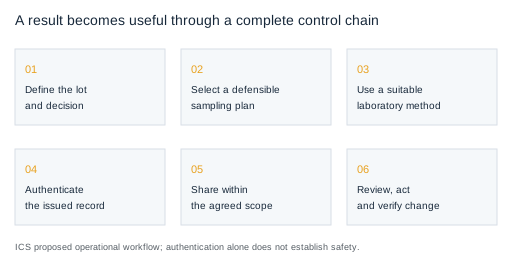
The proposed evidence chain has several distinct jobs: identify material, document sampling, preserve the laboratory report, interpret requirements, control release, and communicate the approved claim. A digital exchange can help preserve links among these records, but it cannot perform every job merely by making the file easier to send. ICS proposes reviewing the chain at each handoff: which assertion is being transferred, who is responsible for it, which underlying record supports it, and what the recipient is allowed to conclude. This is a workflow design, not a claim of deployment or third-party endorsement.
Open full-size figure
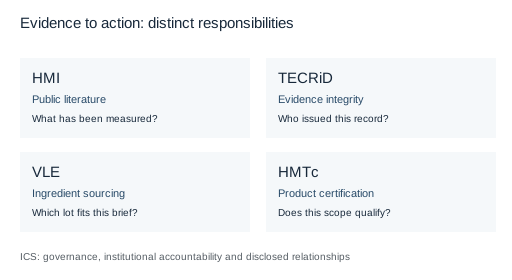
TECRID's operator describes a cryptographically signed, versioned evidence exchange. Authentication concerns origin and integrity of the signed record; it is not proof of sampling quality, analytical validity, safety, or compliance. Private access is not public release. Revoking access cannot erase copies already received. The published supplier route includes private historical-report intake and laboratory confirmation; uploading a PDF does not by itself create a laboratory-issued credential. Demonstration records must remain separate from production evidence. These are documented roles and boundaries, not proof of end-to-end production operation.[20, 21, 22]
Current capability must be stated plainly. All VLE lots displayed during the November 9, 2026 review said No TECRID yet, and VLE disclosed that production TECRID authentication and laboratory ordering were not connected. Its sourcing workflow does not establish a completed purchase; contracts and payment occur off-platform. HMTc's public verification page showed a disabled lookup and specimen rather than an issued certificate. These time-specific observations constrain what may be promised. An ingredient supplier should inspect current onboarding routes and applicable HMTc category standards before proposing an engagement.[23, 24, 25, 26]
Open full-size figure
A practical proposed exchange policy should assign who can issue, revise, withdraw, and receive each record type. Keep the issued laboratory document distinct from a supplier summary and from a buyer's application assessment. If a correction changes a value, scope, or interpretation, preserve the version history and notify relevant recipients. Before adopting a tool, test a simple case with nonproduction data: can the buyer identify the active version, follow the source link, understand the permitted claim, and see a correction? Passing that exercise demonstrates the workflow behavior tested, not the safety of future products.
Measure commercial value without presuming it
The potential commercial value of an evidence-ready offer is reduced decision friction: a buyer may spend less time obtaining missing records, resolving incompatible units, or determining which lot a certificate concerns. These are plausible mechanisms, not outcomes established by this report. A supplier can test them directly. ICS proposes measuring time from a complete technical request to a reviewable dossier, the number of clarification cycles, the proportion of dossiers accepted as complete on first review, and the frequency of avoidable version or identity errors. Define the denominator and starting condition so apparent improvement is not merely a change in the mix of requests.
Separate process outcomes from sales outcomes. A dossier may improve review speed without changing the purchase decision. A sale may occur for price, supply availability, formulation performance, or another reason. Record customer feedback and procurement stages, but do not attribute revenue movement to contaminant evidence solely because the two changed in the same period. A commercial evaluation needs a design capable of examining alternative explanations. This report supplies no causal estimate of sales lift, willingness to pay, reduced litigation cost, or brand protection from adopting the proposed program.
Technical sales can nevertheless make a concrete offer. An ICS model is: we can provide the defined-lot evidence package, explain its sampling and analytical scope, and work with your quality team on the stated application assessment. That is a service promise a supplier can verify operationally. If enhanced evidence access has a cost, specify what the customer receives and what remains outside scope. Avoid charging for an implication of universal safety that the underlying work cannot support. The value proposition should remain intelligible when a result is unfavorable or when the right answer is that additional evidence is needed.
A pilot evaluation should include costs and failures as well as favorable cases. Track laboratory and sampling expenditure, internal review time, delayed decisions, and requests that remain unresolved. Ask whether smaller customers can use the package and whether the record structure survives routine personnel changes. After the pilot, decide which elements are worth standardizing and which require application-specific work. This is an original ICS commercial-learning proposal. Its objective is a measured account of the operating model, with a candid decision about whether to expand, revise, or stop it.
Choose additional contaminants by evidence and use
An ingredient supplier should resist expanding every panel simply because a contaminant is receiving attention. A useful proposed decision considers the material, plausible pathway, intended use, available method, applicable requirement, and action that a result would trigger. A test that cannot be interpreted or connected to a decision may consume resources without improving the dossier. Conversely, a lack of a universal maximum does not prove that testing is unnecessary. The supplier should document the reason for inclusion or exclusion and revisit it when the material, process, customer application, or relevant evidence changes.
PFAS has a distinct regulatory and analytical context. FDA describes food investigations using available toxicological reference values and identifies further bottled-water risk-management work as ongoing; its current page discusses EPA's May 2026 proposal. EU Regulation 2023/915 already contains specified PFAS maximum levels for certain animal foods, fishery products, and eggs. These facts do not establish a total-PFAS limit for every ingredient. For a proposed supplier assessment, identify the individual analytes, reporting basis, relevant food category, and decision method. An EPA tap-water number should not be relabeled as a current FDA ingredient limit.[13, 29]
Microplastics should be described with a different degree of certainty. FDA identifies substantial method and data gaps and says current evidence does not demonstrate that detected food levels pose a human-health risk. EFSA's October 2026 overview says its full food risk assessment is not yet complete and advice is scheduled for completion by the end of 2027. These positions do not prove absence of harm, and they do not supply a universal supplier pass mark. Any exploratory testing should declare its method, particle definition, scope, and interpretive limitations instead of borrowing the language of an established metals specification.[30, 31]
Mycotoxins illustrate why emerging concern and immature regulation are not synonyms. FDA already has a human-food total-aflatoxin compliance policy and a DON advisory level for finished wheat products. Food Standards Scotland's comparison documents commodity-specific mycotoxin rules and differences between GB and EU/NI. A cereal or botanical supplier should therefore ask which toxin and application are relevant, rather than describing the entire category as unregulated. ICS proposes using a separate analyte-and-commodity decision register so a mature requirement is not lost inside a general future-contaminants watchlist.[18, 32, 33]
Three worked supplier decisions
Scenario one concerns a rice-ingredient supplier approached by a buyer making infant cereal for the United States. The buyer forwards FDA's 100 µg/kg inorganic-arsenic infant-rice-cereal action level. The supplier should first confirm the ingredient's intended role and the customer's finished-product category, then distinguish the finished-food guidance from the proposed ingredient acceptance specification. Its dossier should connect the lot, sampling record, species-specific result, and proposed use. If only total arsenic has been measured, the next question is whether that evidence resolves the application or whether further speciation is necessary. The outcome is an application-specific review, not a claim that every rice product from the supplier meets a universal FDA arsenic limit.[9]
Scenario two concerns a botanical powder with two apparently different results. One report uses a dried-material basis; the other concerns a prepared product and has a different reporting limit. Procurement asks which lot is better. ICS proposes pausing that ranking while the laboratory and supplier establish comparability. Record the preparation, basis conversion, analyte definitions, and lot histories, and identify whether a further check would answer the question. If the available data still cannot distinguish the materials, state that finding. A tie caused by limited evidence should not become either a superiority claim or a contamination allegation.
Scenario three concerns a supplier changing a concentration step for a customer selling supplements in several markets. The supplier hypothesizes that the change could alter contaminant concentration, but has not established the direction or size of the effect. An ICS trial would map inputs and outputs, document the process change, use a comparable analytical plan, and assess the customer's maximum daily intake and applicable market framework separately. Health Canada's NHP guidance provides an example of daily-intake acceptance criteria; EU food-supplement requirements illustrate a different category-specific framework. Neither can be applied by copying a number without preserving its scope.[7, 13]
Across all three scenarios, the supplier's next step is concrete: improve the evidence needed for the actual decision and state what remains unresolved. The commercial response can include a time-bound proposal for additional work and an explanation of who will review it. It should not promise that more testing will necessarily produce a favorable result. A program that can support acceptance, rejection, or further investigation under the same stated rules is more coherent than one designed only to produce a favorable marketing certificate. This coherence is a proposed operating principle, not a finding that the scenarios have been field validated.
How this report was assembled and what it cannot establish
This is a selected primary-source review with an evidence cutoff of November 9, 2026. Sources include FDA guidance and regulator announcements, California agency implementation material, OEHHA notices and benchmark tables, EU legal texts, Health Canada lists and guidance, and UK regulator material. The report prioritizes source type, analyte species, product scope, units, and instrument status. Citations identify the sources supporting factual statements. The report does not claim an exhaustive census of legislation, enforcement, ingredient occurrence, supplier practices, or commercial outcomes. It does not report a new sampling campaign.
Access limitations matter. The official 2025 U.S. bottled-water CFR edition was read for the accompanying research pack, but live eCFR and a 2026 annual edition were inaccessible; this report does not use that table to issue a current compliance decision. The EU original act and nickel amendment were read directly, while current 2026 consolidated primary text was available through indexed extraction despite a direct-page JavaScript challenge. CDPH's AB 899 FAQ was available in primary-page search extraction, while direct requests failed. These access conditions limit automated legal determinations and are recorded in the research provenance.
Original ICS proposals are identified in the text and captions. They include the application brief, dossier structure, procurement trials, private-improvement workflow, exchange controls, and commercial metrics. They are reasoned practice designs, not research findings that those interventions have been proven to reduce exposure, increase revenue, or prevent disputes. Hypothetical scenarios and arithmetic examples are explicitly labeled. Numerical legal use still requires review of the current authoritative text and the actual product classification; no regulator or court approval of this report is implied.
Publication should preserve claim boundaries. An excerpt about a regulatory number must retain its species, category, jurisdiction, date, and status. A figure must distinguish a proposed workflow from verified capability. Supplier-specific public claims require evidence about the named material, sampling population, testing status, available response where relevant, and limitations. This general report does not establish that untested material is safe, unsafe, superior, or noncompliant.
Institutional authorship and relationships
The Institute of Contaminant Standards is the publisher and corporate author and the proponent of the ICS proposals. ICS, HMI, and HMTc disclose a shared Paleo Certified, Inc. operator. The TECRID, VLE, and HMTc discussion is institutional context, not independent endorsement. Editorial separation concerns roles, data boundaries, conflicts, and review, rather than separate ownership. The report does not treat a demonstration, exchange record, or finished-product certification as supplier-wide certification.[27, 34]
No private supplier records or customer test data are included in this public-source report. No named ingredient manufacturer is ranked. No legal finding about a supplier is asserted. Any future supplier engagement should disclose the relevant institutional, commercial, and certification relationships and keep private improvement records out of public publication packages unless a properly authorized and lawful release is intended. A required disclosure, reporting, withdrawal, or recall duty remains a separate obligation from any private improvement or communications arrangement.
A practical first implementation
ICS proposes starting with one ingredient family, one defined customer application, and one small cross-functional team. Assign a supplier-quality owner, an analytical reviewer, a regulatory reviewer, and a technical-sales contact. Write the application brief before revising the certificate template. Inventory existing lot and sample records, identify missing links, and decide which gaps affect the intended decision. The first deliverable should be a complete dossier for identified material, with a clear record of assumptions and unresolved questions, rather than a new badge or a universal assurance statement.
Next, run a controlled review with the buyer's designated technical function. Ask whether the dossier supports the stated decision and record what information the reviewer still needs. Test the correction workflow with a nonproduction example. Define the changes that will trigger a renewed assessment and the person responsible for each notification. Measure preparation time, clarification cycles, completeness, cost, and unresolved cases. If the evidence does not support expansion, revise the design. A pilot is useful when it produces an honest operating decision, including a decision to narrow the offer.
Before broader use, approve the exact technical-sales language and the scope of any certification or system claim. Keep the laboratory record, supplier interpretation, buyer assessment, and authorized public statement connected but distinct. Review the requirement map on a defined schedule and when a relevant change occurs. The intended result is a supplier relationship in which each participant can see what has been measured, what has been inferred, what has been decided, and what remains to be done. That is the concrete standard of evidence readiness proposed in this report.
SOURCES REVIEWED
References
- [1]U.S. Food and Drug Administration. (2025, January 6). FDA issues final guidance for industry on action levels for lead in processed food intended for babies and young children. https://www.fda.gov/food/hfp-constituent-updates/fda-issues-final-guidance-industry-action-levels-lead-processed-food-intended-babies-and-young
- [2]U.S. Food and Drug Administration. (2026, October 22). FDA advances Closer to Zero initiative to safeguard food for children. https://www.fda.gov/food/hfp-constituent-updates/fda-advances-closer-zero-initiative-safeguard-food-children
- [3]California Department of Public Health. (n.d.). Assembly Bill (AB) 899: Food safety—Baby food: Frequently asked questions. https://www.cdph.ca.gov/Programs/CEH/DFDCS/Pages/FDBPrograms/FoodSafetyProgram/AB899FAQ.aspx
- [4]European Commission. (2024, July 30). Commission Regulation (EU) 2024/1987 amending Regulation (EU) 2023/915 as regards maximum levels of nickel in certain foodstuffs. https://eur-lex.europa.eu/legal-content/EN/TXT/PDF/?qid=1787104334037&uri=OJ%3AL_202401987
- [5]Health Canada. (2026, July 24). Health Canada's maximum levels for chemical contaminants in foods. https://www.canada.ca/en/health-canada/services/food-nutrition/food-safety/chemical-contaminants/maximum-levels-chemical-contaminants-foods.html
- [6]U.S. Food and Drug Administration. (2026, October). Action levels for cadmium in processed food intended for babies and young children: Draft guidance for industry. https://www.fda.gov/media/195793/download
- [7]Health Canada. (2015, May 1). Quality of natural health products guide (Version 3.1). https://www.canada.ca/content/dam/hc-sc/migration/hc-sc/dhp-mps/alt_formats/pdf/prodnatur/legislation/docs/eq-paq-eng.pdf
- [8]Health Canada. (2026, July 17). Draft for consultation: Quality of natural health products guide: Quality and controls: Purity, stability. https://www.canada.ca/en/health-canada/services/drugs-health-products/public-involvement-consultations/natural-health-products/draft-consultation-quality-natural-health-products-guide/purity-stability.html
- [9]U.S. Food and Drug Administration. (2020, August 5). FDA issues final guidance for industry on action level for inorganic arsenic in infant rice cereals. https://www.fda.gov/food/hfp-constituent-updates/fda-issues-final-guidance-industry-action-level-inorganic-arsenic-infant-rice-cereals
- [10]U.S. Food and Drug Administration. (2023, June 1). FDA issues final guidance to industry on action level for inorganic arsenic in apple juice. https://www.fda.gov/food/hfp-constituent-updates/fda-issues-final-guidance-industry-action-level-inorganic-arsenic-apple-juice
- [11]U.S. Food and Drug Administration. (2010, December). Small entity compliance guide: Current good manufacturing practice in manufacturing, packaging, labeling, or holding operations for dietary supplements. https://www.fda.gov/regulatory-information/search-fda-guidance-documents/small-entity-compliance-guide-current-good-manufacturing-practice-manufacturing-packaging-labeling
- [12]European Commission. (2026, August 19). Consolidated text: Commission Regulation (EU) 2023/915. https://eur-lex.europa.eu/eli/reg/2023/915/eng
- [13]European Commission. (2023, April 25). Commission Regulation (EU) 2023/915 on maximum levels for certain contaminants in food and repealing Regulation (EC) No 1881/2006. https://eur-lex.europa.eu/eli/reg/2023/915/oj/eng/pdf
- [14]Office of Environmental Health Hazard Assessment. (n.d.). Proposition 65 no significant risk levels (NSRLs) and maximum allowable dose levels (MADLs). https://oehha.ca.gov/proposition-65/general-info/proposition-65-no-significant-risk-levels-nsrls-and-maximum-allowable-dose-levels-madls
- [15]Office of Environmental Health Hazard Assessment. (2019, May 2). Proposition 65 definition of nickel (soluble compounds). https://oehha.ca.gov/proposition-65/crnr/proposition-65-definition-nickel-soluble-compounds
- [16]Health Canada. (2026, July 24). List of contaminants and other adulterating substances in foods. https://www.canada.ca/en/health-canada/services/food-nutrition/food-safety/chemical-contaminants/contaminants-adulterating-substances-foods.html
- [17]Food Standards Agency. (2018, January 30). Chemical contaminants. https://www.gov.uk/government/publications/chemical-contaminants/chemical-contaminants
- [18]Fera Science Ltd. (2026, May 25). Chemical contaminants in plant based protein survey: Section 2. https://www.foodstandards.gov.scot/science-and-evidence/chemical-contaminants-in-plant-based-protein-survey/section-2
- [19]Pendergrass, K. (2026, August 20). The readiness pathway. https://heavymetalcertified.com/program/readiness
- [20]Institute of Contaminant Standards. (2026, August 29). What is a TECRID? https://tecrid.com/what-is-a-tecrid
- [21]Institute of Contaminant Standards. (n.d.). TECRID for brands and ingredient suppliers: Verifiable COA portfolios. https://tecrid.com/for-brands
- [22]Institute of Contaminant Standards. (n.d.). TECRID for certifiers, retailers and regulators: Structured laboratory evidence. https://tecrid.com/for-certifiers-retailers
- [23]Verified Lot Exchange. (n.d.). Know what is in the lot before you buy it. https://vle.exchange/
- [24]Verified Lot Exchange. (n.d.). How does this work? https://vle.exchange/how-it-works
- [25]Heavy Metal Tested & Certified. (n.d.). Verify a certificate. https://heavymetalcertified.com/verify
- [26]Heavy Metal Tested & Certified. (n.d.). HMTc standards. https://heavymetalcertified.com/standards
- [27]Pendergrass, K. (2026, April 24). About. https://heavymetalindex.com/about
- [28]Pendergrass, K. (2026, August 20). Testing should create a plan, not a trap. https://heavymetalcertified.com/for-brands
- [29]U.S. Food and Drug Administration. (n.d.). Per- and polyfluoroalkyl substances (PFAS). https://www.fda.gov/food/environmental-contaminants-food/and-polyfluoroalkyl-substances-pfas
- [30]U.S. Food and Drug Administration. (n.d.). Microplastics and nanoplastics in foods. https://www.fda.gov/food/environmental-contaminants-food/microplastics-and-nanoplastics-foods
- [31]European Food Safety Authority. (2026, October 21). Microplastics and nanoplastics in food. https://www.efsa.europa.eu/en/topics/microplastics-and-nanoplastics-food
- [32]U.S. Food and Drug Administration. (2021, June 1). Compliance Policy Guide: Section 555.400—Aflatoxins in human food. https://www.fda.gov/media/149666/download
- [33]U.S. Food and Drug Administration. (2010, July). Guidance for industry and FDA: Advisory levels for deoxynivalenol (DON) in finished wheat products for human consumption and grains and grain by-products used for animal feed. https://www.fda.gov/regulatory-information/search-fda-guidance-documents/guidance-industry-and-fda-advisory-levels-deoxynivalenol-don-finished-wheat-products-human
- [34]Institute of Contaminant Standards. (n.d.). Governance. https://contaminantstandards.com/governance
Institute of Contaminant Standards. (2026). From Ingredient Lots to Defensible Evidence. ICS Evidence Review. ICS-ER-2026-004, version 1.0.1.
Publication package SHA-256: 6262eee12206df18329d0047841822f1a8a327fcf6008e86c33c20e76a909a93Version history and file fingerprints