
HEAVY METALS SPECIAL REPORT
Contaminant Assurance at the Shelf
Heavy-metal scrutiny, supplier evidence and a practical control system for food and supplement retailers
Version 1.0.1 · Evidence checked through 2026-11-09 · Free download
Retailers need a reliable way to connect the products on their shelves with the evidence supporting their sourcing decisions. A certificate of analysis can contain useful measurements while leaving the buyer unable to establish who issued it, which lot it represents, whether it has changed, or what action followed the result. This report proposes a purchasing and evidence-control system that gives each of those questions an accountable owner. The immediate objective is to make supplier assurance operational: a result is requested, authenticated, interpreted against the correct requirement, acted on and retained.
The public record demonstrates several different forms of pressure. The cinnamon-applesauce investigation led to a multibrand recall and subsequent retailer enforcement follow-up. Published protein and rice testing expanded scrutiny of everyday ingredients and products. FDA has also published infant-formula monitoring with an overall reassuring assessment. These findings should be read together. Attention, detection, an enforcement letter and a finding of harm are different things; a useful retail policy must respond to the actual evidence in each case.[1, 2, 3, 4, 5]
Our recommended first step is a bounded supplier pilot: require private access to authenticated laboratory evidence for selected products, designate technical reviewers, preserve the version reviewed, and define corrective action and escalation. TECRiD offers a free core for verifiable evidence, subject to issuer and access requirements. HMTc certification is a separate product-level pathway; VLE is a developing ingredient-sourcing route whose production authentication integrations remain incomplete in the current public offering. Adoption should proceed through verified capabilities and measured milestones.[6, 7, 8, 9]
ICS publishes this report and is affiliated with the services it discusses. The case for the operating controls stands on the cited evidence and the practical tools below. The proposed workflow, pilot targets and hypothetical examples are ICS recommendations, not findings that a particular retailer failed to use these controls. This review establishes neither an exhaustive ranking of brands nor a quantified sales benefit from joining the ecosystem.
The decisions this report should change
Start with a decision that the business actually makes. A merchant admits a new SKU, a distribution center receives a shipment, a quality team approves a specification, or a store removes a recalled item. Each decision uses a different evidence scope. Product onboarding may rely on a baseline dossier. Lot release requires a lot relationship. A consumer claim needs a substantiation record. A recall instruction needs an accurate inventory and distribution map. Combining all four into a generic annual document request leaves uncertainty about which decision the document supports.
The proposed retail system has three owners. Procurement owns the commercial condition and makes it explicit before onboarding. Quality owns the technical interpretation, including product basis, sampling limitations and escalation. Operations owns the movement of affected stock and evidence that a disposition was carried out. Legal and communications teams join when the evidence creates disclosure, contract or public-representation questions. An account manager can coordinate the workflow but should not silently become the authority who declares a contaminant result acceptable.
For executives, the central question is whether the organization can reconstruct a sourcing decision without relying on an employee inbox. For technical teams, it is whether the record supports the particular product and decision. For merchants, it is whether a supplier has an attainable route to meet the requirement and improve. A program that only collects documents can look complete while still failing each of these tests. The checklists in this report are designed to expose those gaps before a category-wide rollout.
| Decision | Evidence scope | Accountable outcome |
|---|---|---|
| Admit a product | Identity, intended use, applicable rules, baseline testing and supplier controls | Named quality approval and stated limits |
| Accept an in-scope lot | Lot mapping, suitable sample, current issued record and review | Release, conditional administrative hold or escalation |
| Make a quality claim | Exact wording, applicable standard and supporting evidence | Approved claim and refresh trigger |
| Respond to a recall | SKU/lot distribution, stock locations and removal instruction | Verified withdrawal and reconciliation |
Where scrutiny is concentrated, and where it is widening
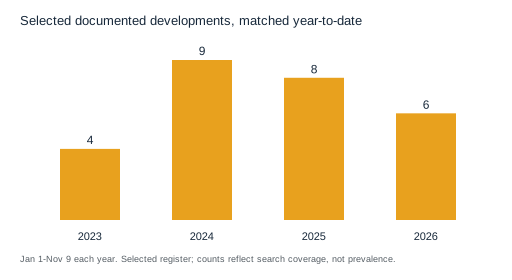
The selected record identifies recurring pressure around baby foods, cocoa products, rice, spices and supplements, with additional attention to protein products, cassava foods and formula. It does not provide a complete denominator of all brands, tests or enforcement actions. Accordingly, this report describes documented developments and operational implications rather than declaring a universal league table of the most dangerous products. The same product category can contain both concerning samples and substantially better-performing samples.
The 2023 cinnamon-containing applesauce investigation is a high-consequence ingredient case. FDA investigated elevated lead and chromium in products associated with WanaBana, Schnucks and Weis. The shared ingredient route matters for a retailer: three branded products may be affected by one upstream problem. A procurement file organized only by brand can miss common-source exposure. The control implication is to retain enough ingredient and manufacturing information to identify related products when a supplier or ingredient becomes a concern.[10]
The 2025 protein-testing methods published by Consumer Reports describe 23 product models with two or three tested samples or lots per model. Its comparison assumes a daily serving and expressly does not establish Proposition 65 compliance or the point at which harm occurs. That is useful information about selected products and the communication challenge around serving-based exposure. It is not a representative prevalence estimate for protein products or a basis for rejecting every product in the category.[3]
Healthy Babies Bright Futures reported inorganic arsenic in its 145-sample rice subset in 2025. Its wider appendix includes other grains, so the rice denominator must remain distinct. A retailer can use the investigation to prioritize questions about rice-based ingredients and child-directed uses. It should not apply an infant-rice-cereal benchmark automatically to every bag of ordinary rice, or equate detection with the same regulatory status across commodities.[4]
Cassava illustrates why conflicting-looking findings need context. CFIA published a Canadian targeted survey in 2026 covering 261 cassava samples collected in 2023-2024. Health Canada did not identify a health concern in those tested samples. A retailer should preserve that assessment alongside analytical detections. Geography, products, sample selection and the assessment method can differ from a US publication; the results cannot be collapsed into a single global cassava safety verdict.[11]
Open full-size figure
Operationally, rising scrutiny should mean a change in the questions asked, not merely a change in the length of the watchlist. A category entering a new testing campaign may need a prepared explanation of sample scope. A new regulatory instrument requires a classification and effective-date check. A recall in a common ingredient calls for source mapping. A lawsuit involving retailer representations calls for a review of what the retailer promises and the evidence behind those promises.
What the numbers can tell a buyer
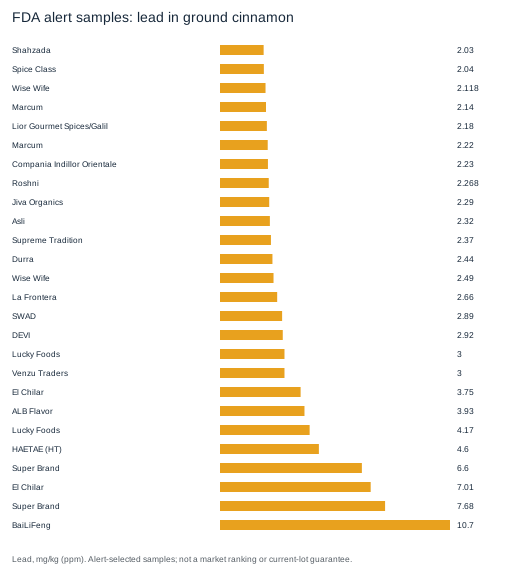
FDA ground-cinnamon alerts provide an inspectable example of measurements that deserve action within their stated scope. The combined alert includes numerical results from selected products and has continued to receive additions through November 4, 2026. This report reproduces the printed results as a selected-alert dataset. It does not know the sample size or collection date behind every table entry. A date when FDA added an entry is not automatically the date the sample was purchased or tested.[12]
The plot is useful because it preserves a common analytical unit and a reasonably consistent product form. It is still not a market distribution. Products entered the alert because of concerns and investigations, so the dataset overrepresents selected adverse findings by design. It cannot estimate the probability that an arbitrary shelf product exceeds a benchmark. Nor does the rightmost bar imply that all products made by that company are worse than another company's products. The relevant purchase decision concerns the product and lot evidence available now.
Before comparing results, require the product basis. A concentration in dry powder is not the same quantity as a concentration in prepared food. FDA's formula materials illustrate this distinction: earlier market-basket summaries used as-prepared values, whereas its testing materials also provide as-sold results and explain dilution. A buyer must not divide or multiply by an assumed dilution factor without retaining the preparation instruction and calculation. That is a measurement-control task even when the original laboratory result is authentic.[14]
An illustrative arithmetic example makes the issue concrete. Suppose a hypothetical product contains 0.20 milligrams of lead per kilogram and its stated serving is 10 grams. The concentration converts to 200 micrograms per kilogram; multiplying by 0.010 kilograms gives 2 micrograms per serving. This calculation says nothing by itself about legal compliance, daily consumption, absorption or harm. It simply converts concentration to the amount in that serving. The retailer still needs the correct use pattern and applicable assessment framework.
| Check | Question to resolve |
|---|---|
| Product and preparation | Dry, wet, reconstituted, edible portion or another defined basis? |
| Analyte identity | Total element or specified chemical species? |
| Unit and denominator | Concentration, amount per serving or daily intake? |
| Sampling scope | One portion, composite, multiple lots or a designed survey? |
| Analytical limit | Is the reporting limit suitable for the decision? |
| Time and status | Does the record apply to this lot, and has it been amended? |
Open full-size figure
The regulatory map a retailer actually needs
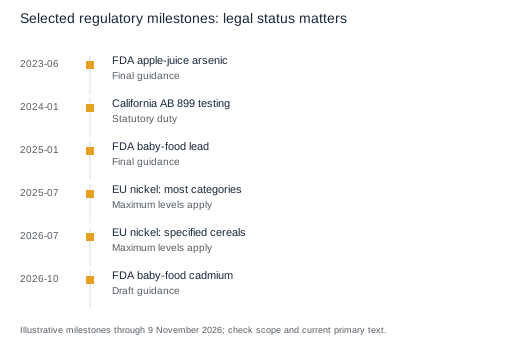
A retail requirement should name the governing instrument, the product category, the analyte and the comparison basis. FDA guidance, a California disclosure obligation and an EU maximum level serve different functions. Treating them as interchangeable numbers creates both false reassurance and unnecessary rejection. The right first step is a scoped register for the retailer's assortment, maintained by the team responsible for regulatory interpretation.
FDA's January 2025 final lead guidance covers specified processed foods represented for babies and young children under two. The scope excludes infant formula, beverages and snacks such as puffs and teething biscuits. The guidance establishes action levels rather than a universal statutory concentration table for every food. A retailer should check the exact product category before telling a supplier that a particular FDA action level applies. A product outside this guidance is not thereby exempt from other food-safety requirements.[15]
FDA released draft baby-food cadmium action levels on October 22, 2026. At this report's cutoff, the document is a proposal and is marked not for implementation. It belongs in the planning watchlist, with its status displayed next to any value. A retailer may decide to investigate readiness for a proposed level, but should describe that as its own purchasing policy or preparation activity rather than asserting that the draft already creates a binding federal limit.[16]
California AB 899 adds a different requirement: monthly testing for specified metals in covered baby foods beginning in 2024 and public test-result information from 2025. The law does not itself supply a new universal numerical pass/fail table. CDPH's implementation FAQ also distinguishes the product scope and the conditions affecting label-link duties. Retailers operating in California need evidence of the applicable testing and disclosure process, not just a concentration result that happens to look low.[17]
EU nickel requirements are already part of current compliance planning. Regulation 2024/1987 applies most listed food maximum levels from July 1, 2025, with specified cereal entries applying from July 1, 2026 and transitional provisions for previously lawfully marketed food. That is different from California's listing of nickel soluble compounds for reproductive toxicity. A total-nickel laboratory result must not be described as if it automatically established the scope of a soluble-compound hazard listing.[18, 19]
Canada uses commodity-specific maximum levels across its incorporated list and additional Health Canada maximum-level materials. The United Kingdom also needs a more precise geographic label: the applicable frameworks in Great Britain and Northern Ireland can differ. The FSA and Food Standards Scotland materials identify the relevant retained or EU instruments. For a retailer importing products or operating across markets, destination-specific classification should precede comparison, especially for compound foods and products whose preparation changes the analytical basis.[20, 21, 22, 23]
Open full-size figure
What documented retailer requirements already show
Retailer requirements can translate an abstract concern into a condition of commercial access. CVS supplier terms describe qualification testing, a Tested to Be Trusted process, routine monitoring and documentation requirements. The appendix includes metals among the relevant testing considerations and makes the supplier responsible for specified qualification steps and charges. The useful lesson is the existence of an explicit process and consequence. It does not establish that every lot of every listed product has been tested.[25]
Amazon's April 2024 supplement announcement similarly ties eligibility to verification by approved testing, inspection and certification organizations and warns that unconfirmed listings may be removed by applicable dashboard deadlines. That is evidence of a marketplace access mechanism. It is not a measured count of products removed, a guarantee of subsequent batch performance, or a statement that an unrelated verification service automatically satisfies Amazon's requirements. A supplier's current marketplace request remains the operative instruction.[26]
A documented CVS withdrawal also illustrates the importance of precise public wording. Its July 2024 psyllium notice says the product failed program requirements but does not identify the failed attribute. This report therefore does not label it a heavy-metal recall. Retailer teams should apply the same discipline to their own notices: explain the reason that has actually been established and avoid filling an evidentiary gap with an assumption.[27]
A useful procurement requirement has four parts. First, the supplier knows which products and events trigger submission. Second, the required package is specific enough to produce comparable evidence. Third, the retailer names who may accept or reject it. Fourth, the contract and operating procedure state what happens when the package is incomplete, late, amended or concerning. A mandate that stops at account creation may produce enrollment statistics without producing usable assurance.
The proposed TECRiD requirement in this report should be evaluated against those four parts. Brands would authorize a defined retailer to receive relevant records privately. Approved laboratory issuance and verification would address origin and integrity. Retailer quality review would address technical adequacy and acceptance. Escalation and corrective action would remain assigned business functions. This is an implementation proposal for retailer review; it is not a claim that either CVS or Amazon currently uses TECRiD.
| Requirement | What makes it reviewable |
|---|---|
| Covered products and lots | SKU identifiers, lot definitions and explicit exclusions |
| Submission trigger | Onboarding, new lot, material supplier change, retest or incident |
| Evidence standard | Issued source record, required metadata and current status |
| Private access | Named retailer recipient, authorized fields and permitted use |
| Review owner | Technical reviewer and alternate, with recorded decision |
| Exception route | Temporary administrative handling, escalation and closure evidence |
Palmquist: the retailer lesson and the limits of the case
Palmquist is especially relevant to a retailer that makes public quality or vetting representations. In its May 28, 2024 opinion, the Fifth Circuit considered whether Whole Foods had been improperly joined and whether the federal court could retain the case after removal. It concluded that the retailer should not have been dismissed on that basis, reversed the refusal to remand, and vacated the federal judgment. The analysis addressed a plausible claim at the relevant procedural stage; it did not establish that the allegations were true.[28]
On February 24, 2026, the Supreme Court affirmed the jurisdictional outcome. An erroneous dismissal of a nondiverse party had not cured the defect in removal jurisdiction. The decision did not determine whether the foods caused the alleged injuries or whether Hain or Whole Foods was liable. This distinction is necessary to make the case useful to a sophisticated legal and quality audience. A strong operational lesson does not need an inaccurate account of the holding.[29]
Hain's annual report for the fiscal year ended June 30, 2026 says the matter was pending in Brazoria County, Texas, with discovery ongoing and trial set to begin March 29, 2027. That is the company's disclosure as of filing, not an independently refreshed state-court docket entry. The company disputes the allegations. Readers should verify the current court setting before reusing this case in a later publication or presentation.[30]
The ICS inference is that retailer quality promises should be backed by an evidence and decision record that can be reconstructed. A hypothetical retailer with private access to authenticated results, suitable sampling, a clear review policy and a functioning response process could identify and address some concerns earlier. Each condition matters. Merely putting a certificate into a registry would not establish that a retailer noticed a concerning result, interpreted it correctly or acted on it.
The public record reviewed here does not establish exactly which documents Whole Foods held, which particular result would have changed its decision, or whether TECRiD would have prevented the lawsuit. Those facts must not be invented to make the product story stronger. The credible case study asks a narrower and more useful question: what controls would a retailer want available when it needs to explain how its sourcing representations related to the evidence?
Evidence access must connect to shelf action
The FDA warning letter to Dollar Tree in June 2024 concerns a different problem from authenticity. FDA described failures in the effectiveness of recalled-product removal following the cinnamon-applesauce recall. The dated letter is an agency enforcement position and should be read in that context. It nevertheless gives retailers a concrete operational case: a communication that a recall exists and a control that physically removes affected product are not the same deliverable.[2]
A retailer evidence program should therefore connect quality decisions to inventory and store execution. The minimum working record includes the affected product identifier, lot/date scope if known, locations holding stock, the instruction sent, acknowledgment by responsible operators, disposition and reconciliation. When lot mapping is incomplete, the team needs a documented decision about the scope of the hold. It should not wait for a perfect digital integration before activating an established recall or withdrawal procedure.
Run a dry recall drill using fictional product identifiers and no customer-facing message. Have the quality lead issue an internal test instruction, identify inventory in each channel, collect acknowledgments and reconcile the quantities located. Record the time taken and the unanswered questions. Test online listings, warehouse stock, store shelves, returns and third-party fulfillment where those channels are actually in scope. A pilot is more informative when it includes a difficult record or missing lot code than when every sample is prepared in advance.
The same discipline applies to corrected laboratory records. A revised report can create a need to revisit the original acceptance decision, but a correction does not always mean that the product must be recalled. The technical significance, distribution status and applicable requirements determine the response. TECRiD documents version and status history; the retailer still needs a person or service that receives the update and a workflow that assigns a review. Test delivery and acknowledgment instead of assuming that a change visible in a registry has reached every buyer.[7]
| Field | What to record |
|---|---|
| Trigger | Simulated recall or changed evidence, time received and source |
| Scope | Product, lot, dates, channels and unresolved identity gaps |
| Instruction | Action owner, deadline and escalation contact |
| Execution | Inventory located, removed/held and reconciled |
| Evidence update | Reviewed record version, consequence and reviewer |
| Closure | Outstanding discrepancies, corrective action and retest date |
The supplier evidence specification
An evidence request should be detailed enough that two suppliers can answer it in a comparable way. Begin with the commercial object: exact product name, SKU or GTIN where applicable, manufacturer, relevant site, lot definition and intended market. Add the sampling object: who selected the sample, when, what portion it represents, whether it was a composite and how it was identified. Then request the analytical record. A supplier that lacks a field should state that absence rather than substitute a confident narrative.
Laboratory metadata should include the issuer, report identifier, date, method, analyte identity, result, unit, reporting limits and basis. Relevant accreditation scope can be part of competence review, but the buyer should not treat the existence of an accreditation logo as proof that every reported method or matrix falls within scope. The sample and technical record must be evaluated together. The proposed specification deliberately asks for these fields before any platform-specific identifier.
For an authenticated record, retain the TECRiD, issuing organization, current status, version and the retailer's authorized evidence package. TECRiD documents the role of issuer signatures and record fingerprints. A forwarded PDF or an identifier printed on a document is not equivalent to completed production issuance. A historical report may be useful during intake, but its status needs to remain visible until the appropriate laboratory confirmation or issuance occurs.[31, 32]
Permission should be limited to the retailer and the fields it needs for the agreed purpose. A buyer can request evidence and negotiate participation as a purchasing condition; that does not mean it may publish the supplier's measurements. The data-use arrangement should define permitted use, recipients, retention, correction handling and any onward disclosure process. Legal obligations remain relevant. Technical withdrawal of a future access grant cannot remove an earlier copy already downloaded or relied upon.[33]
| Part | Required content |
|---|---|
| Identity | SKU/product, manufacturer, lot or justified scope, intended market |
| Sampling | Selector, date, sample identity, design and chain-of-custody information available |
| Analysis | Laboratory, method, analyte/species, result, units, basis, LOD/LOQ |
| Authority | Issued report identity and relevant laboratory competence/scope |
| Integrity | Signed record or clearly labeled intake status; version and current status |
| Review | Applicable requirement, reviewer, disposition and unresolved questions |
| Change control | Notification route, amendment handling and retained receipt |
Ask suppliers to explain the mapping between an ingredient result and a finished product when that mapping is used. An ingredient measurement may help diagnose a problem or evaluate a proposed reformulation, but it does not automatically certify the finished food. Conversely, a finished-product result can conceal important variation between incoming lots if the sampling strategy is poorly matched. The evidence specification should state which decision each record supports and what additional work is needed.
A review and escalation matrix that people can use
Completeness, authenticity and technical acceptability are separate review questions. The proposed matrix starts with completeness because missing identity or basis can make a numerical comparison meaningless. It then asks whether the record can be authenticated. Finally, a qualified reviewer decides whether the sample and analysis support the purchasing decision against the correct requirement. A green authentication indicator should never automatically become a green product-release indicator.
An administrative hold can be appropriate when required documentation is missing, but its scope and commercial treatment need to be defined by the retailer's own policy. A technically concerning result needs a different route: determine the affected scope, preserve the evidence, involve the responsible quality and legal functions, and decide on the necessary stock and communication actions. The matrix below does not prescribe a universal legal response to every result. It is an operating template to adapt to the retailer's category and jurisdiction.
| Observed issue | Immediate review task | Closure evidence |
|---|---|---|
| Missing lot or product identity | Resolve applicability before relying on the result | Documented product/lot mapping |
| Unconfirmed or altered source | Obtain issuer confirmation or valid issued record | Verified provenance and current version |
| Wrong basis or species | Request clarification, suitable conversion or analysis | Traceable corrected comparison |
| Result above applicable criterion | Escalate for technical/legal assessment and stock decision | Recorded disposition and corrective action |
| Superseded or revoked record | Revisit any decisions that relied on it | New review linked to original receipt |
| Pass with material uncertainty | Decide whether additional sampling is needed | Explicit rationale and follow-up trigger |
Use a decision log with a short structured rationale. It should say what requirement applied, which version of the evidence was reviewed, what the reviewer concluded and why. Avoid a checkbox that says only compliant. If a result falls below a purchasing criterion but a sampling concern remains, record both facts. If a supplier receives time to complete an administrative requirement, record who authorized that interval and what stock controls apply in the meantime.
Escalation also needs coverage for absences and weekends. A system that routes every alert to one individual may work during a demonstration and fail during a real incident. Establish an alternate reviewer and a way to verify receipt of urgent changes. A small pilot can test these controls with synthetic record amendments, access withdrawal and deliberate missing fields. The success criterion is that the team reaches and records the intended decision, not that every simulated event produces a favorable result.
A confidential route to better performance
Suppliers need a way to investigate and improve without treating every preliminary result as a public marketing event. HMTc's published readiness pathway describes confidential pre-certification review, quantitative results and a corrective roadmap before the certification decision. Its current program rules reserve the mark for Certified status; remediation is unmarked. These are program descriptions, not evidence that a particular supplier has already reduced contamination or earned a certificate.[34, 35]
A retailer can support that route by defining what remains private and what must be disclosed for the retailer's decision. For example, a brand may share the current product result, the action plan, the responsible owner and follow-up evidence with the retailer while keeping supplier negotiations and preliminary sourcing discussions within a smaller team. The intended design is to give suppliers room for careful investigation while preserving the retailer's access to information needed for its decision; no measured effect on supplier behavior is established here. Required reporting, withdrawal and recall obligations remain applicable.[36]
The practical improvement loop starts by locating the contribution. Examine relevant ingredients, processing water, equipment contact, packaging or another plausible pathway using a qualified investigation. Establish a comparable baseline, choose an intervention and repeat testing on the same analytical basis. A better result in a single new lot is encouraging but does not isolate the cause or demonstrate sustained process control. Maintain the intervention record and enough follow-up to understand whether the change persists.
VLE can be introduced as an ingredient-sourcing route within this process, with precise current-state language. The public exchange displays supplier lots and documentation, while its current pages state that production TECRiD authentication and laboratory ordering are not connected. A buyer can evaluate the available sourcing workflow and participate in its development; it should not treat a documented lot or sandbox link as authenticated production evidence. The immediate purchasing decision still requires the appropriate review.[9, 37]
For suppliers already performing well, the opportunity is to make that performance easier to inspect. A coherent dossier, consistent product identity and a verifiable source can reduce avoidable ambiguity. These are intended operational benefits. Claims about saved hours, greater sales or lower contamination should follow measurement in the retailer's pilot. The same system should make it possible to see a strong record without concealing an unfavorable result or overstating the scope of a certification.
How the ecosystem fits together
Open full-size figure
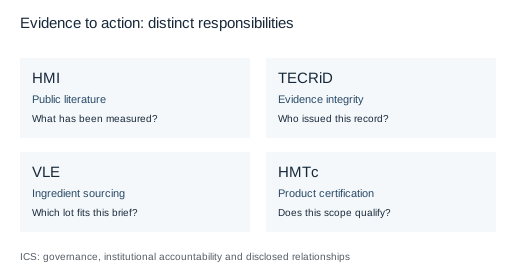
HMI is the starting point for understanding published evidence and the limits of that evidence. It can inform category questions and help a technical team trace a regulatory or scientific argument. Its public literature role should remain separate from private supplier laboratory records. Moving an applicant's results into a public literature index would change the nature of both systems and is not the pathway proposed here.[38]
TECRiD addresses provenance, integrity, versions and controlled evidence access. Its core is offered free, with optional paid implementation support. That removes a published core software price barrier, but it does not make sampling, laboratory analysis, staff time or integration free. A retailer evaluating total participation cost should distinguish those components. Production laboratory authority and suitable scope remain requirements even when the account or registry function has no core fee.[6, 41, 42]
HMTc provides the distinct published-standard and certification pathway. The applicable category, native basis, edition and product scope matter. The public verification page observed at this cutoff is pending and displays a specimen rather than an issued production certificate. The retailer should therefore use the current standards and readiness/application routes for evaluation and verify an actual certificate only when an issued record is available. This report does not use a specimen as proof of certification.[8, 43]
ICS's governance materials disclose shared operation and describe accreditation and committee development as work in progress. Readers should evaluate the published safeguards and present status directly. The institutional relationship is relevant because this report recommends engagement with affiliated services. It is disclosed here so the report can be judged on the evidence, operational design and observed capabilities, with appropriate scrutiny of the claims.[40]
Trust, sales and the business case without invented ROI
The evidence in this review establishes commercial mechanisms more clearly than it establishes a universal financial effect. Recalls remove specified products from sale, marketplace requirements can condition listing eligibility, qualification programs impose work and fees, and litigation can demand management and legal resources. These mechanisms matter to a retailer even when a source cannot isolate an exact percentage change in sales or consumer trust attributable to heavy-metal scrutiny.[25, 26, 44]
Publix's 2025 GreenWise baby-food recall is a scoped example. Its announcement identified a pear, kiwi, spinach and pea pouch, described removal and refunds, and reported no illnesses at that time. The documented business consequence is the product-specific recall response. A claim that the event caused a measured brand-wide revenue loss would require additional evidence. The report therefore does not turn a recall notice into an invented financial case study.[44]
Build the retailer's business case from its own baseline. Measure staff time spent locating documents, the proportion of packages with identity gaps, time to resolve a record amendment, and the share of covered decisions with a complete review trail. Those quantities can be observed without claiming that the platform prevents litigation. When calculating avoided rework, record the actual before-and-after process and the number of comparable cases. Account for changes in assortment and staffing that could otherwise explain the improvement.
A hypothetical example is useful only when it remains visibly hypothetical. If a quality team reviews 200 packages in a quarter and the measured average time falls from 30 minutes to 20 minutes for comparable work, the arithmetic difference is about 33 staff-hours. Those inputs are invented to demonstrate the calculation, not a TECRiD performance result. Implementation, laboratory and training costs still belong in a complete assessment. Any public claim should use the retailer's observed data and a defensible comparison.
Consumer reassurance requires its own evidence. A technically accurate message can still be misunderstood. Test whether shoppers understand the scope of a statement such as product tested against a named standard, the date or edition, and what the mark does not establish. Questions received by customer service can reveal recurring misunderstandings, but the count depends on sales volume and the way contacts are coded. Measure questions per relevant exposure or transaction where possible, and retain the exact wording tested.
| Measure | Denominator or comparison | Interpretation |
|---|---|---|
| Evidence turnaround | Comparable complete requests | Workflow speed |
| Complete review trail | Covered decisions | Process coverage |
| Exceptions resolved | Exceptions opened in the same cohort | Closure performance |
| Contaminant change | Comparable follow-up samples/lots | Measured change with sampling limits |
| Customer questions | Relevant transactions or contacts | Communication signal |
| Adoption | Eligible invited suppliers | Participation, not safety outcome |
PFAS, microplastics and mycotoxins: different questions
An adaptable evidence system should be able to receive results for more than metals, but it should not pretend that every contaminant has equally mature analytical and regulatory interpretation. PFAS, microplastics and mycotoxins require distinct requests, analyte definitions and review expertise. Expanding a metal checklist by adding three generic boxes would hide the differences that make the results useful.
FDA's PFAS materials distinguish environmental contamination, assessment of food, and specified food-contact uses. The agency describes the end of US sales of certain grease-proofing agents and related food-contact notification changes; this does not mean that all PFAS in every material or food are covered by a single ban. The EU also has maximum levels for specified PFAS in specified animal foods. A buyer needs the exact analyte panel and commodity scope, not a claim that a result represents every PFAS substance.[45, 46]
For microplastics, FDA identifies substantial method and data gaps and says the current evidence does not demonstrate that the detected levels in foods pose a human-health risk. EFSA's October 2026 overview describes further assessment work scheduled through 2027. Neither statement supplies a universal food pass/fail threshold. Retailers considering testing should first define the decision it would inform, how particle identity and size would be measured, and how uncertainty would be communicated.[47, 48]
Mycotoxins already have commodity-specific compliance and advisory frameworks. FDA's aflatoxin compliance policy and its deoxynivalenol guidance for finished wheat products are examples. An ingredient buyer may need mycotoxin evidence alongside metals, with a sampling plan suitable for the contaminant and material. This is a reason to maintain a flexible evidence specification, not a reason to substitute one test panel for another.[49, 50]
For each emerging topic, record what has changed: a measurement method, an actual finding, a new risk assessment, a legal instrument, a retailer request or public attention. These changes have different consequences. A future scientific assessment can justify watching the issue without inventing a regulatory deadline. A binding commodity-specific maximum can justify an immediate compliance mapping exercise. This distinction keeps a watchlist useful to buyers rather than turning it into a list of unresolved fears.
A 90-day pilot and the evidence required to expand it
The following timeline is an ICS planning template. It is not a promise of integration speed or a minimum legal compliance schedule. An active contamination concern must follow the retailer's applicable response process immediately. For routine adoption, a bounded pilot allows the retailer to discover its evidence gaps, laboratory participation needs and reviewer workload before setting an assortment-wide deadline.
| Period | Work | Exit evidence |
|---|---|---|
| Days 1-15 | Choose category and covered decisions; inventory current evidence; assign owners | Baseline register, supplier list, scope and escalation contacts |
| Days 16-30 | Agree data-use terms; onboard sample suppliers and laboratories; test private access | Verified identities, permissions and complete trial packages |
| Days 31-60 | Run actual covered reviews; test amendments, missing fields and recall drill | Decision logs, exception queue and drill reconciliation |
| Days 61-90 | Evaluate process coverage and costs; review follow-up data; adjust supplier requirement | Measured results, limitations and documented rollout decision |
Use a mixture of records in the pilot. Include a clean complete package, one with an ambiguous product basis, a historical report awaiting issuer confirmation and a corrected record. These cases should be clearly identified as test exercises when synthetic. The point is to discover whether the workflow handles exceptions, not to create a demonstration in which every supplier passes. Record every place where staff leave the system to use email or a spreadsheet so the true process can be assessed.
Define expansion criteria before seeing the results. Suitable criteria include the proportion of covered decisions with a complete source-to-review trail, reliable routing of urgent changes, resolution of permissions questions and sufficient reviewer capacity. The retailer should choose the required level based on its context rather than adopting an invented universal percentage from this report. Contaminant reduction is a separate outcome requiring comparable follow-up testing and enough time to assess the intervention.
At the close of the pilot, issue a short internal decision record. State what worked, which integrations were actually tested, what remains manual, which supplier groups need support and what evidence would justify expansion. If a feature remains unavailable, describe the temporary process and owner instead of declaring completion. This record is the basis for a phased purchasing requirement that brands can understand and the retailer can enforce consistently.
Explore TECRiD evidence access for retailers
Review the free-core participation path
Methods, limitations and institutional disclosure
The evidence cutoff is November 9, 2026. The review prioritized primary government and court records, original testing methods and datasets, public retailer requirements, company disclosures and first-party ecosystem documentation. The scrutiny window begins in January 2023; older scientific or regulatory sources are used where necessary to explain a continuing requirement or historical dataset. References are numbered in first-use order and provide the publication or source identity needed to inspect the claim.
The event register is a selected evidence inventory assembled for this report series. It is not a systematic census of news, litigation, recalls, brands or laboratory results. Related updates are grouped where they describe the same underlying event; substantive legal or regulatory milestones can remain separately labeled developments. The annual graphic uses matching January 1-November 9 periods and is explicitly descriptive of the register. It should not be used to estimate public concern, contamination prevalence or comparative brand performance.
The measurement graphic uses the numerical results printed in FDA's combined cinnamon alert table. Units are normalized from parts per million to the equivalent milligrams per kilogram. Sample counts and collection dates are left unknown when the source does not state them. Multiple results from a product remain separate printed observations; they are not silently averaged into a brand score. The downloadable selected-evidence register preserves the original source IDs and limitations so that calculations can be reproduced.
Legal status is checked against the cited opinions and the latest company filing located for the case. A later docket development may change a future setting. Regulatory descriptions distinguish proposals, guidance, statutory duties and enforceable maximum levels. This report is a decision-support publication; a retailer's product classification, contract and response require review against the current applicable facts and instruments. No proposed checklist in the report claims to create a legal safe harbor.
ICS is the institutional author and publisher. The Institute is affiliated with HMI, HMTc, TECRiD and VLE through the disclosed ecosystem and common operation described in its governance materials. This is not an independent endorsement by an unrelated institution. Public capability statements were reviewed alongside current interfaces where available; that review did not conduct production onboarding, issue laboratory credentials, place an order or measure customer outcomes. Intended benefits remain identified as proposals until supported by observed results.[40]
Each publication version is generated from one canonical narrative, reference list and figure dataset for both HTML and PDF. The package fingerprint identifies the source state. Corrections should describe the affected claim, source and interpretation rather than silently replacing a material finding. The free online edition is the starting point for locating a later version. Readers can use the tools directly while retaining the limitations and source scope that make them meaningful.
SOURCES REVIEWED
References
- [1]U.S. Food and Drug Administration. (n.d.). Post-incident response activities: Elevated lead and chromium levels in cinnamon applesauce pouches. https://www.fda.gov/food/outbreaks-foodborne-illness/post-incident-response-activities-elevated-lead-and-chromium-levels-cinnamon-applesauce-pouches
- [2]U.S. Food and Drug Administration. (2024, June 11). Dollar Tree Inc. — 674301 — 06/11/2024. https://www.fda.gov/inspections-compliance-enforcement-and-criminal-investigations/warning-letters/dollar-tree-inc-674301-06112024
- [3]Consumer Reports. (2025, October). Test methodology: Heavy metals in protein supplements. https://article.images.consumerreports.org/image/upload/v1761140939/prod/content/dam/CRO-Images-2025/Special%20Projects/Consumer-Reports-Protein-Powders-and-Shakes-Contain-High-Levels-of-Lead-Methodology-Test-Results-v2.pdf
- [4]Healthy Babies Bright Futures. (2025, May 27). What’s in your family’s rice? https://hbbf.org/sites/default/files/2025-05/Arsenic-in-Rice-Report_May2025_R6_SECURED.pdf
- [5]U.S. Food and Drug Administration. (2026). FDA’s infant formula product testing results. https://www.fda.gov/food/infant-formula-homepage/fdas-infant-formula-product-testing-results
- [6]Institute of Contaminant Standards. (n.d.). Join TECRID. https://tecrid.com/join
- [7]Institute of Contaminant Standards. (n.d.). TECRID for certifiers, retailers and regulators: Structured laboratory evidence. https://tecrid.com/for-certifiers-retailers
- [8]Heavy Metal Tested & Certified. (n.d.). HMTc standards. https://heavymetalcertified.com/standards
- [9]Verified Lot Exchange. (n.d.). Know what is in the lot before you buy it. https://vle.exchange/
- [10]U.S. Food and Drug Administration. (n.d.). Investigation of elevated lead & chromium levels: Cinnamon applesauce pouches (November 2023). https://www.fda.gov/food/outbreaks-foodborne-illness/investigation-elevated-lead-chromium-levels-cinnamon-applesauce-pouches-november-2023
- [11]Canadian Food Inspection Agency. (2026). Toxic metals in selected foods — April1, 2023, to March31, 2024. https://publications.gc.ca/collections/collection_2026/acia-cfia/A104-247-1-2026-eng.pdf
- [12]U.S. Food and Drug Administration. (2026, November 4). More ground cinnamon products added to FDA public health alert due to presence of elevated levels of lead. https://www.fda.gov/food/alerts-advisories-safety-information/more-ground-cinnamon-products-added-fda-public-health-alert-due-presence-elevated-levels-lead
- [13]U.S. Food and Drug Administration. (2026, October 22). FDA advances Closer to Zero initiative to safeguard food for children. https://www.fda.gov/food/hfp-constituent-updates/fda-advances-closer-zero-initiative-safeguard-food-children
- [14]U.S. Food and Drug Administration. (2026). FDA’s testing of infant formula. https://www.fda.gov/food/infant-formula-homepage/fdas-testing-infant-formula
- [15]U.S. Food and Drug Administration. (2025, January 6). FDA issues final guidance for industry on action levels for lead in processed food intended for babies and young children. https://www.fda.gov/food/hfp-constituent-updates/fda-issues-final-guidance-industry-action-levels-lead-processed-food-intended-babies-and-young
- [16]U.S. Food and Drug Administration. (2026, October). Action levels for cadmium in processed food intended for babies and young children: Draft guidance for industry. https://www.fda.gov/media/195793/download
- [17]California Department of Public Health. (n.d.). Assembly Bill (AB) 899: Food safety—Baby food: Frequently asked questions. https://www.cdph.ca.gov/Programs/CEH/DFDCS/Pages/FDBPrograms/FoodSafetyProgram/AB899FAQ.aspx
- [18]European Commission. (2024, July 30). Commission Regulation (EU) 2024/1987 amending Regulation (EU) 2023/915 as regards maximum levels of nickel in certain foodstuffs. https://eur-lex.europa.eu/legal-content/EN/TXT/PDF/?qid=1787104334037&uri=OJ%3AL_202401987
- [19]Office of Environmental Health Hazard Assessment. (2019, May 2). Proposition 65 definition of nickel (soluble compounds). https://oehha.ca.gov/proposition-65/crnr/proposition-65-definition-nickel-soluble-compounds
- [20]Health Canada. (2026, July 24). List of contaminants and other adulterating substances in foods. https://www.canada.ca/en/health-canada/services/food-nutrition/food-safety/chemical-contaminants/contaminants-adulterating-substances-foods.html
- [21]Health Canada. (2026, July 24). Health Canada's maximum levels for chemical contaminants in foods. https://www.canada.ca/en/health-canada/services/food-nutrition/food-safety/chemical-contaminants/maximum-levels-chemical-contaminants-foods.html
- [22]Food Standards Agency. (2018, January 30). Chemical contaminants. https://www.gov.uk/government/publications/chemical-contaminants/chemical-contaminants
- [23]Fera Science Ltd. (2026, May 25). Chemical contaminants in plant based protein survey: Section 2. https://www.foodstandards.gov.scot/science-and-evidence/chemical-contaminants-in-plant-based-protein-survey/section-2
- [24]U.S. Food and Drug Administration. (2023, June 1). FDA issues final guidance to industry on action level for inorganic arsenic in apple juice. https://www.fda.gov/food/hfp-constituent-updates/fda-issues-final-guidance-industry-action-level-inorganic-arsenic-apple-juice
- [25]CVS Pharmacy, Inc. (n.d.). Dropship terms and conditions, Appendix 3: Tested to Be Trusted program. https://cvssuppliers.com/sites/launch/files/2025-07/CVS%20Dropship%20T%26C%20FINAL.pdf
- [26]Amazon Seller Central. (2024). Listings Lounge: New requirements for dietary supplements. https://sellercentral.amazon.com/seller-forums/discussions/t/3c89099d-06aa-453f-95a6-a2eea54260ab
- [27]CVS Pharmacy. (2024, July 12). CVS Health Natural Fiber Supplement 100% Psyllium: Product information. https://www.cvs.com/content/dam/enterprise/cvsretail/help-assets/recall_pdf/Final-CVS%20Health%20Psyllium%20Fiber%20Supplement%20SKU%20689581.pdf
- [28]U.S. Court of Appeals for the Fifth Circuit. (2024, May 28). Palmquist v. Hain Celestial Group, Inc., No. 23-40197, 103 F.4th 294. https://www.ca5.uscourts.gov/opinions/pub/23/23-40197-CV0.pdf
- [29]Supreme Court of the United States. (2026, February 24). The Hain Celestial Group, Inc. v. Palmquist, No. 24-724, 607 U.S. ___. https://www.supremecourt.gov/opinions/25pdf/24-724_igdj.pdf
- [30]The Hain Celestial Group, Inc. (2026, September 14). Annual report on Form 10-K for the fiscal year ended June 30, 2026. https://www.sec.gov/Archives/edgar/data/910406/000119312526390505/hain-20260630.htm
- [31]Institute of Contaminant Standards. (n.d.). TEC Registry API: Canonicalize, sign, issue, resolve. https://tecrid.com/developers
- [32]Institute of Contaminant Standards. (n.d.). TECRID for brands and ingredient suppliers: Verifiable COA portfolios. https://tecrid.com/for-brands
- [33]Institute of Contaminant Standards. (2026, August 29). TECRID privacy and data governance. https://tecrid.com/privacy
- [34]Pendergrass, K. (2026, August 20). The readiness pathway. https://heavymetalcertified.com/program/readiness
- [35]Pendergrass, K. (n.d.). Program structure. https://heavymetalcertified.com/program/structure
- [36]Pendergrass, K. (2026, August 20). Corrective action. https://heavymetalcertified.com/program/corrective-action
- [37]Verified Lot Exchange. (n.d.). How does this work? https://vle.exchange/how-it-works
- [38]Pendergrass, K. (2026, April 24). About. https://heavymetalindex.com/about
- [39]Institute of Contaminant Standards. (2026, August 29). What is a TECRID? https://tecrid.com/what-is-a-tecrid
- [40]Institute of Contaminant Standards. (n.d.). Governance. https://contaminantstandards.com/governance
- [41]Institute of Contaminant Standards. (n.d.). TECRID for laboratories: Issue verifiable laboratory reports. https://tecrid.com/for-laboratories
- [42]Institute of Contaminant Standards. (n.d.). TECRID frequently asked questions. https://tecrid.com/faq
- [43]Heavy Metal Tested & Certified. (n.d.). Verify a certificate. https://heavymetalcertified.com/verify
- [44]Publix Super Markets, Inc. (2025, May 9). Publix voluntarily recalls GreenWise Pear, Kiwi, Spinach & Pea baby food pouches due to lead. https://www.fda.gov/safety/recalls-market-withdrawals-safety-alerts/publix-voluntarily-recalls-greenwise-pear-kiwi-spinach-pea-baby-food-pouches-due-lead
- [45]U.S. Food and Drug Administration. (n.d.). Per- and polyfluoroalkyl substances (PFAS). https://www.fda.gov/food/environmental-contaminants-food/and-polyfluoroalkyl-substances-pfas
- [46]European Commission. (2023, April 25). Commission Regulation (EU) 2023/915 on maximum levels for certain contaminants in food and repealing Regulation (EC) No 1881/2006. https://eur-lex.europa.eu/eli/reg/2023/915/oj/eng/pdf
- [47]U.S. Food and Drug Administration. (n.d.). Microplastics and nanoplastics in foods. https://www.fda.gov/food/environmental-contaminants-food/microplastics-and-nanoplastics-foods
- [48]European Food Safety Authority. (2026, October 21). Microplastics and nanoplastics in food. https://www.efsa.europa.eu/en/topics/microplastics-and-nanoplastics-food
- [49]U.S. Food and Drug Administration. (2021, June 1). Compliance Policy Guide: Section 555.400—Aflatoxins in human food. https://www.fda.gov/media/149666/download
- [50]U.S. Food and Drug Administration. (2010, July). Guidance for industry and FDA: Advisory levels for deoxynivalenol (DON) in finished wheat products for human consumption and grains and grain by-products used for animal feed. https://www.fda.gov/regulatory-information/search-fda-guidance-documents/guidance-industry-and-fda-advisory-levels-deoxynivalenol-don-finished-wheat-products-human
Institute of Contaminant Standards. (2026). Contaminant Assurance at the Shelf. ICS Evidence Review. ICS-ER-2026-002, version 1.0.1.
Publication package SHA-256: a04dcf0ed4aff9237c087bc3f43a4d2399d6b32f8898761589074fd790a88f4cVersion history and file fingerprints