HEAVY METALS SPECIAL REPORT
Ingredient sourcing with lot-linked evidence
Current VLE availability and an ICS proposed method for a controlled sourcing pilot
Version 1.0.1 · Evidence checked through 2026-11-09 · Free download
Lot-level sourcing works best when the physical offer, its evidence and the buyer's decision rule stay connected. Current VLE provides public discovery and a described buyer/supplier workflow; the public workflow states that production TECRID authentication and laboratory ordering are not connected. This companion distinguishes that current state from an ICS proposed pilot method. It provides buyer and supplier review tools, a fictional cocoa example, an integration acceptance checklist and measures for testing potential operational value. It reports no completed purchasing outcome, measured time saving or contamination reduction.[1, 2]
The purchasing decision starts with a physical lot
An ingredient purchase creates a practical evidence question: which physical material is the buyer considering, and which record actually describes it? A useful sourcing system must keep that question visible from the first conversation to the release decision. A supplier's general specification, an older report from another lot, a brand certificate and a current test result can each be informative, yet answer different questions. The purchasing team needs a way to record the difference before treating the documents as interchangeable.
VLE's present proposition is to bring documented lots and supplier conversations together. The public site allows discovery of a first supplier and explains a buyer/supplier workflow. It should presently be considered a sourcing and evidence-review entry point. Its public boundaries explicitly distinguish original reports, supplier assertions, buyer evaluations, test credentials and certification. The current public workflow states that production laboratory authentication and ordering are not yet connected. These boundaries determine what an adoption pilot can responsibly promise.[1, 2]
The main recommendation of this companion is an ICS proposed operating method: hold three identities together. First, identify the lot and the quantity being considered. Second, identify the exact evidence available for that lot, including what is missing. Third, identify the buyer's decision rule and who approved it. A conversation can progress commercially while one of these remains unresolved, but the decision record should never imply that the unresolved item was checked.
Open full-size figure
What a visitor can verify today
This report uses a read-only inspection on November 9, 2026 of the live VLE domain, delivered public workflow modules and anonymous catalogue data. The public catalogue presents Kasandrinos and six documented lots. Its anonymous production-proof projection displays no attached production TECRID; the test references are explicitly sandbox records. These observations establish a public discovery surface. They do not establish a completed purchase or authenticated production exchange, rule out private credentials, or test protected integrations.[1]
| Surface | Observed or published state | Adoption implication |
|---|---|---|
| Supplier and lot discovery | Public supplier/lot pages and original-report labels | Use to identify a candidate and its evidence questions. |
| Buyer and supplier desks | Published private-need and conversation workflow; account sign-in required, with controller approval additionally required for original reports | Evaluate with authorized accounts before promising completed operational service. |
| Laboratory authentication and ordering | Public workflow states that production authentication and ordering are not connected | Keep test credentials and production evidence separate. |
| Soft hold | Described as an intention with supplier confirmation | Do not equate it with a purchase order, inventory guarantee or contract. |
| Payment and contract | Handled off-platform | The buyer retains its normal commercial approval and contracting process. |
The proposed pilot should therefore begin with a bounded review of one supplier, one ingredient and a small number of clearly identified candidate lots. The objective is to learn whether the team can find and resolve evidence gaps before a purchasing commitment. It is premature to promise a fully automated qualified-lot marketplace, instant laboratory ordering, a fixed authentication turnaround or a known reduction in contamination. Each would need its own evidence and acceptance test.
A deployment version or successful software test is useful implementation information, but a buyer needs a different kind of assurance: an authorized person can use the intended workflow with the intended data and receive the expected result. This report did not create an account, upload a report, contact a supplier, order testing, place a hold or complete a sale. Published features are therefore described as published, with operational outcomes left unmeasured.
Separate the evidence objects before comparing lots
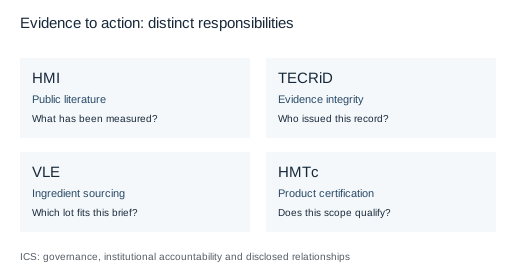
A buyer should ask what each document is allowed to establish. A TECRID authenticates a laboratory evidence record and its history; the receiving organization still judges suitability and conformance. HMTc publishes product-specific standards, and its certification claim is limited to the stated product and requirements. HMI provides public literature context rather than a private brand-COA database. Combining these resources does not remove their separate boundaries.[4, 5, 6, 7]
| Object | Useful question | Question it cannot settle alone |
|---|---|---|
| Supplier specification | What is the supplier offering or promising? | Was this exact physical lot tested and found within the buyer's requirement? |
| Original laboratory report | What did the named laboratory report for the submitted sample? | Does the sample represent every unit now offered? |
| Authenticated evidence record | Who signed this record, which version is current, and what changed? | Does the result satisfy this buyer's technical or legal decision? |
| Product certificate | What exact item, standard, period and scope are covered? | Is a separate ingredient, supplier or later lot automatically certified? |
| Buyer evaluation | What did this purchasing team conclude for its intended use? | Has the laboratory or certifier endorsed every part of that conclusion? |
An efficient review begins with the weakest identity link. If the supplier lot code on the offered material differs from the report, resolve that first. If the buyer cannot tell whether a concentration refers to the material as sold or another preparation basis, resolve that before performing a numerical comparison. If a report is only a supplier transcription, ask where the original resides and whether the issuer can authenticate it. A well-designed interface should make unknowns visible instead of converting them to a favorable default.
Ingredient screening and finished-product certification should also remain separate decisions. A buyer may set an ingredient specification to support a formulation, but should document how it was derived and who owns that judgment. It should not copy a finished-product limit into an ingredient purchase order and assume equivalence. The proposed evidence ledger should retain the intended use, preparation context and product-standard link so a later reviewer can reconstruct why a requirement was chosen.
An ICS proposed buyer intake method
The following method is proposed by ICS for a first authorized pilot; it is not a claim that every field or automated check is currently implemented in VLE. Its purpose is to help a purchasing lead and a quality lead agree what must be resolved before a lot can progress. Keep the pilot narrow enough that each exception has a named owner and can be closed on evidence.
- Create a private need record naming ingredient identity, intended use, amount, destination, decision deadline and the quality owner. Record whether the requirement is an internal purchasing specification, an applicable legal requirement or a certification requirement.
- Attach the decision rule with its version and basis. Identify analytes, units, reporting requirements, required sample identity and any specialist review. A missing rule is an open question; it is not permission to use a convenient supplier threshold.
- Build a candidate-lot ledger. Retain the supplier's exact lot code, any packaging or release identifiers, quantity offered, evidence dates and document identifiers. Do not merge similarly named lots without an explicit identity explanation.
- Request only the evidence needed for the decision and record the controller's permission. Private sourcing notes should stay within the buyer's authorized account; a shared summary should be a deliberate separate artifact.
- Assign each gap to an owner and a next action. Examples include obtaining an original report, confirming a unit, asking for an issuer correction or commissioning an appropriate new sample. Avoid a single vague label such as documents incomplete.
- Authorize progression explicitly. A quote, a sample request and a soft hold can be recorded as commercial stages; the quality release decision should name the reviewed evidence and unresolved conditions.
The team should create a short handoff note at each commercial stage. The note should say what changed, who accepted it and what remains unresolved. For example, agreement to pay for shipping says nothing about whether the sample is acceptable for the intended analytical question. Acceptance of a sample says nothing about release of the later commercial lot. A purchasing system helps only when these different acceptances remain visible.
For privacy review, distinguish internal notes from evidence shared with a supplier and from information sent to another recipient. A buyer's commercial urgency does not create permission to disclose private laboratory findings. TECRID's public materials describe recipient-specific grants controlled by the brand or supplier, including scope and expiry. A pilot should test that the selected permission matches the intended recipient and purpose before using any private record.[8, 9]
An ICS proposed supplier response pack
A supplier gains a practical opportunity when it can answer a specific need with a specific lot and a clear account of what is documented. The proposed response pack is deliberately small. It should help the buyer determine relevance quickly without asking the supplier to publish every commercial detail or private result to the open web. Actual upload, review and sharing permissions must follow the deployed service and the supplier's authorization.
Start with the physical offer: exact lot identity, ingredient description, location, available quantity and any limitations on that quantity. Add a document list that distinguishes original laboratory reports, supplier declarations, certifications and explanatory correspondence. For each item, record the document's subject, date, scope and current status. Where a document covers several lots or a shared sample, retain that fact instead of presenting it as an individual-lot result.
The supplier should state three categories of information separately: confirmed facts, supplier representations and open questions. That separation can reduce repetitive clarification in principle, but the amount of time saved remains a pilot outcome. It also gives the supplier a fair way to say that a result is not available or that a buyer's requested basis differs from the basis of its existing report. A gap can be addressed; an undisclosed substitution is much harder to explain.
Before a quote or sample is accepted, agree which material will be sent, which question testing is intended to answer, who selects the laboratory, how costs are allocated and what would trigger another sample. Record who can disclose the resulting report. This agreement is a proposed project control, not a claim that VLE currently places laboratory orders. The public site expressly states that production ordering is not connected.[2]
When evidence changes, the supplier should update the buyer through an agreed route and identify the affected offer. A corrected report should not silently replace the record that supported an earlier discussion. Preserve the original reference and the correction link, then request a new buyer evaluation where needed. TECRID's documented version model is relevant to this task, but the pilot must confirm the actual correction delivery path rather than assuming that all connected parties automatically receive it.[10]
Laboratory and integration boundaries
TECRID describes an issuer process using a reviewed laboratory key, Ed25519 signatures, record fingerprints and preserved versions. Laboratory production authority is gated separately from workspace access. Its free core and optional implementation support are different commercial choices from issuer approval. These are useful conditions for an integration discussion, but none establishes that a VLE production receiver is currently delivering authenticated results.[10, 11, 12]
Open full-size figure
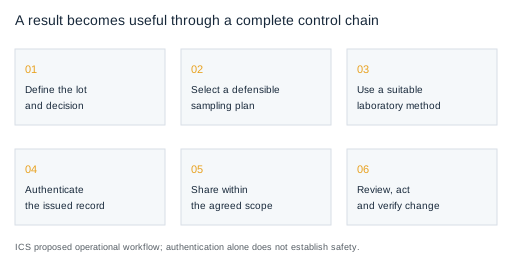
An ICS proposed technical acceptance checklist should test failure paths as well as a successful demonstration. A result for the wrong supplier or ambiguous lot should remain unattached. A sandbox identifier should not appear as production proof. A missing private grant should not be repaired by exposing a public result. An older event should not undo a newer correction. A withdrawn grant should stop future authorized delivery without pretending to erase copies already received.
For a first laboratory conversation, ask for a compact written boundary: which workflow is being integrated, which organization can issue, which organization controls disclosure, which recipient receives data, and which party operates correction monitoring. The answer should identify the current environment and the next production gate. Avoid using the phrase integrated unless its scope is immediately stated. A link to a test record, a documented endpoint and a real production delivery are different achievements.
The buyer should retain an ordinary fallback during a pilot. If a status cannot be refreshed, the record should move to an unresolved review state with a named human owner. A team can choose a cautious purchasing action without inventing the missing status. That fallback also creates useful pilot data: which checks depended on automation, which required issuer response, and how long each exception remained open.
Worked hypothetical: a cocoa ingredient purchase
A brand plans a production run and needs 800 kilograms of cocoa powder. Procurement opens a private need record for the intended formulation and destination. Quality attaches an internally approved purchasing specification and identifies who can decide equivalence if a supplier's report uses a different preparation basis. The team sets a decision date. This first step makes the commercial need explicit without claiming that the internal specification is itself an HMTc ingredient certification standard.
Supplier A offers Lot CP-A and provides an original report whose lot identifier matches. Supplier B offers Lot CP-B with an older report for CP-B0 and a statement that the source is unchanged. The ledger records the distinction. The buyer may continue a quote discussion with either supplier, but should not label CP-B as analytically confirmed by the CP-B0 report. The proposed next action is an identity explanation or new evidence, assigned to the supplier contact and the buyer's quality reviewer.
The CP-A report contains a reporting basis the buyer has not yet reconciled with its requirement. Instead of performing an undocumented conversion, the reviewer records basis unresolved and asks for the necessary method and preparation information. A procurement manager can see why the decision is pending without reading private analytical details. If a summary is shared outside the buyer account, the team deliberately selects the content and recipient rather than forwarding the entire internal review.
Suppose the supplier later provides an authenticated corrected record. The buyer checks which version was reviewed previously, what changed and whether the correction affects the intended use. The hypothetical correction does not automatically make the ingredient acceptable. Quality applies its own rule and records either acceptance, a conditional next step or rejection for the stated use. Procurement then confirms the available quantity and contract terms through the ordinary commercial process.
The pilot's useful result is not a promise that one supplier is universally better. It is a reconstructable decision: CP-A was selected or withheld for specified reasons, CP-B's evidence gap stayed visible, and the team can identify what it relied on. If a soft hold is requested, the record should name its expiry and supplier response while preserving VLE's boundary that a hold is not a completed purchase. The contract, payment and later receipt inspection remain separate controls.[1]
Measure potential value before making a benefit claim
The proposed first pilot should compare an existing document process with an authorized VLE-assisted process for a bounded set of sourcing cases. Start by recording the current process before introducing a new tool. Otherwise a team may remember only its most frustrating historical case and mistake that comparison for evidence. Use equivalent starting and ending points, such as first complete need to quality decision, and report both elapsed time and staff effort.
| Proposed measure | What to record | Interpretation boundary |
|---|---|---|
| Evidence completeness | Required fields present, missing and resolved at each stage | A complete file can still contain unsuitable evidence. |
| Identity exceptions | Lot, supplier, product or document mismatches requiring review | More exceptions found initially may reflect better detection. |
| Handling effort | Minutes spent collecting, transcribing, verifying and following up | Do not infer overall time savings from one shorter task. |
| Decision elapsed time | Start/end timestamps and time waiting on another party | Delay can arise from laboratory or commercial dependencies. |
| Correction response | Time to identify affected decisions and obtain current evidence | A test notification is not proof of every production recipient's response. |
Report failures and unknowns alongside successful cases. A blocked grant, a corrected sample identity or an unavailable laboratory response can be more informative than a smooth demonstration. Separate the number of records received from the number technically accepted and the number used in a purchasing decision. Neither a page visit nor a successful API receipt proves that a human reviewed the evidence.
Choose continuation criteria in advance. For example, the pilot may require that every selected candidate lot has a documented evidence disposition and every unresolved item has an owner, without requiring that every candidate pass. A future quantified benefit should identify the denominator, observation period, comparator, labor assumptions and exclusions. Claims about lower contamination, fewer disputes or legal protection require additional evidence beyond improved document handling.
Role-specific next steps and limitations
A buyer can begin with public lot discovery, then read the workflow before opening a private sourcing desk. A supplier can review the supplier desk entry and prepare a specific-lot evidence pack. A laboratory should first read both TECRID issuer requirements and VLE's current integration boundary. A certification or retailer team should define its own receiving criteria and permission needs before requesting a new technical connection. None of these first steps requires treating a demonstration credential as production evidence.
Open the buyer desk; sign-in and permissions apply
Open the supplier desk; sign-in and permissions apply
Read TECRID laboratory onboarding requirements
Find an applicable finished-product standard
The principal limitation is the gap between public workflow description and a completed authorized production workflow. This inspection did not test private account isolation, report delivery, laboratory issuance, supplier fulfillment or downstream status handling. The present public VLE labels are appropriately narrower than an automated qualified-lot claim. The proposed checklists in this report are ICS recommendations for pilot design, not measured service performance or a representation that each control is already deployed.
ICS publishes this companion and operates related evidence and certification resources under a disclosed institutional relationship. The report is therefore institutional guidance about an affiliated ecosystem, not independent third-party endorsement. Public-source observations support the dated capability descriptions. The workflow design, example and measurement plan are explicitly ICS proposals. Their value should be assessed through documented authorized use, with technical, purchasing and legal decisions remaining with the responsible organizations.[3]
REFERENCES & INSTITUTIONAL RECORDS
References
- [1]Verified Lot Exchange. (n.d.). Know what is in the lot before you buy it. https://vle.exchange/
- [2]Verified Lot Exchange. (n.d.). How does this work? https://vle.exchange/how-it-works
- [3]Institute of Contaminant Standards. (n.d.). Governance. https://contaminantstandards.com/governance
- [4]Pendergrass, K. (2026, April 24). About. https://heavymetalindex.com/about
- [5]Institute of Contaminant Standards. (2026, August 29). What is a TECRID? https://tecrid.com/what-is-a-tecrid
- [6]Institute of Contaminant Standards. (n.d.). TECRID for certifiers, retailers and regulators: Structured laboratory evidence. https://tecrid.com/for-certifiers-retailers
- [7]Pendergrass, K. (2026, August 20). Testing should create a plan, not a trap. https://heavymetalcertified.com/for-brands
- [8]Institute of Contaminant Standards. (n.d.). TECRID for brands and ingredient suppliers: Verifiable COA portfolios. https://tecrid.com/for-brands
- [9]Institute of Contaminant Standards. (2026, August 29). TECRID privacy and data governance. https://tecrid.com/privacy
- [10]Institute of Contaminant Standards. (n.d.). TECRID for laboratories: Issue verifiable laboratory reports. https://tecrid.com/for-laboratories
- [11]Institute of Contaminant Standards. (n.d.). TEC Registry API: Canonicalize, sign, issue, resolve. https://tecrid.com/developers
- [12]Institute of Contaminant Standards. (n.d.). Join TECRID. https://tecrid.com/join
Institute of Contaminant Standards. (2026). Ingredient sourcing with lot-linked evidence. ICS Institutional Analysis. ICS-IA-2026-006, version 1.0.1.
Publication package SHA-256: 647ac421388e906fc19f209a344929cdcec182c92a6e87f883095834f24b2c33Version history and file fingerprints